
Choosing the right finish for your timber deck can feel like a gamble. You stand there, looking at the options, worried about making a costly mistake that will peel, fade, or look patchy in just a few months. It’s a common fear, and a valid one. That’s why we’re putting one of Australia’s popular choices under a professional microscope: the Wattyl Weathergard Water-Based Decking Stain/Oil. Is it a genuine performer that protects your investment, or just another can full of empty promises?
Forget the marketing hype you read on the tin. In this honest, no-shortcuts review, we’ll give you our expert assessment based on real-world application. We’ll break down exactly how it performs, the critical preparation steps most people skip, and the application secrets to achieving a durable, professional-grade finish on your deck. By the end, you’ll know with confidence whether this is the right product for your project.
Key Takeaways
- The success of your deck coating depends more on preparation than the product itself. Learn why professional sanding is the non-negotiable first step for a finish that actually lasts.
- Understand what ‘water-based oil’ really means for your deck’s appearance and longevity. We break down its hybrid acrylic formula and what that means for performance in the Australian climate.
- Get our honest, field-tested verdict on Wattyl Weathergard Water-Based Decking Stain/Oil. Discover the specific situations where we recommend it and when an alternative product is a smarter choice.
- Avoid common DIY mistakes like lap marks and patchiness. We reveal the professional application method that guarantees a smooth, even finish, going beyond the basic instructions on the can.
What is Wattyl Weathergard? An Expert Breakdown
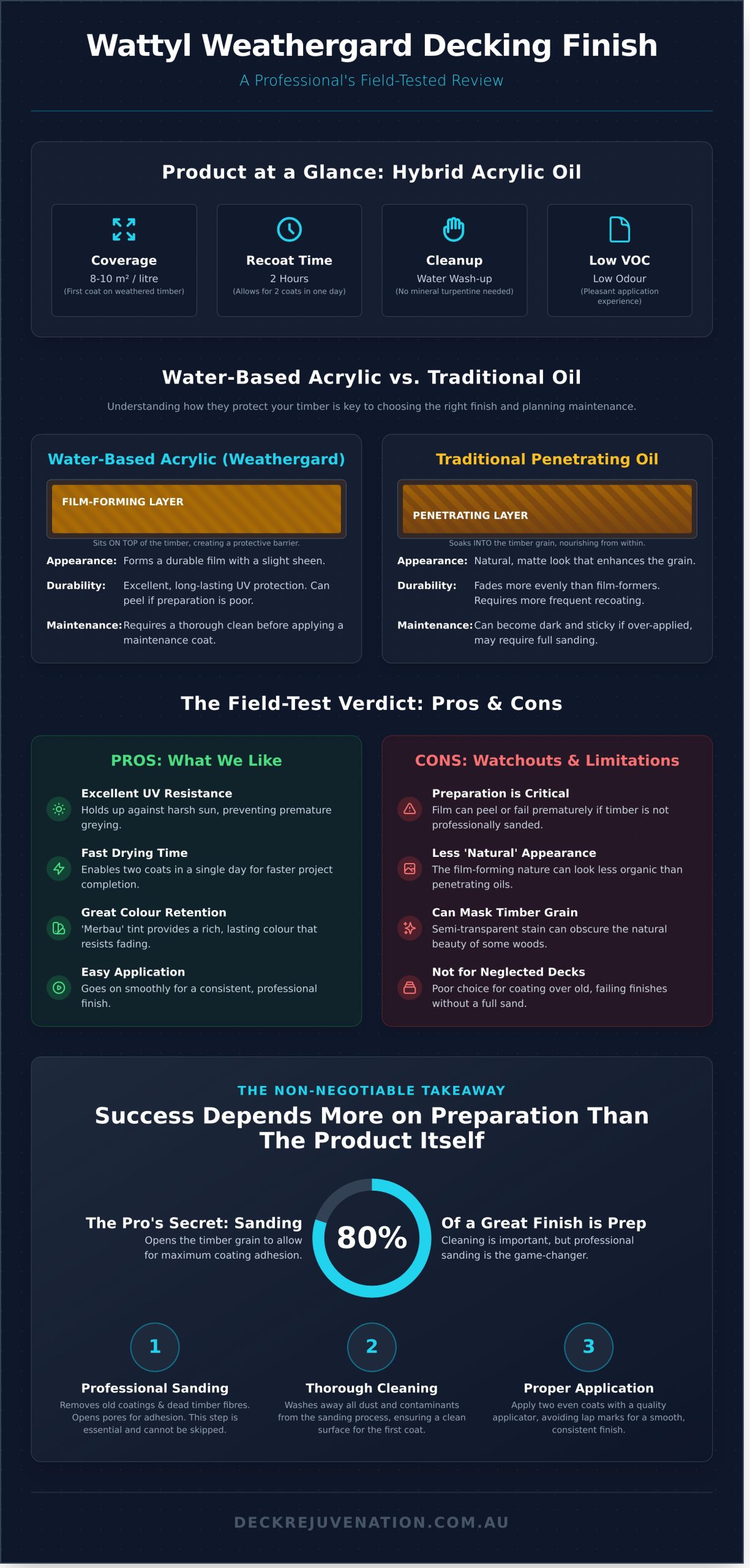
Let’s cut through the marketing noise. The term “water-based decking oil” can be confusing, because traditional oils and water don’t mix. The Wattyl Weathergard Water-Based Decking Stain/Oil is what we in the trade call a hybrid acrylic oil. It combines the durable, film-forming protection of an acrylic resin with nourishing oils, all suspended in a water-based solution. It’s designed to both protect and colour the timber-if you’re new to these products, understanding what is a wood stain provides excellent background. This modern formulation is engineered for Australian conditions, protecting exterior timber like decks, stairs, and handrails from harsh sun and rain.
From a professional’s standpoint, its primary features are durability and UV resistance. Unlike penetrating oils that can fade quickly, Weathergard forms a tough, flexible film on the timber’s surface. This barrier provides excellent protection against foot traffic and shields the wood from greying under intense UV exposure. It is available in two main semi-transparent colours: ‘Natural’ enhances the existing grain and colour of your timber, while ‘Merbau’ imparts a rich, reddish-brown hue, perfect for popular hardwoods or for evening out the tone of an older deck.
Key Features & Technical Specs
On the job, performance specs matter more than marketing claims. Here’s what you can genuinely expect:
- Coverage: The tin says up to 12m² per litre, but on the first coat over porous, weathered timber, expect closer to 8-10m². The second coat will go much further.
- Recoat Time: A fast 2-hour recoat time is a huge advantage. It means we can apply two coats in a single day, getting the job done efficiently without compromising quality.
- Cleanup: Simple water wash-up. No need for expensive and smelly mineral turpentine, which makes the entire process cleaner and safer for your property.
- VOC Content: This is a low-VOC (Volatile Organic Compounds) product. The low odour makes for a much more pleasant application experience for both us and you, the homeowner.
Water-Based vs. Traditional Oil-Based: A Quick Comparison
Understanding the difference is crucial for long-term maintenance. While both protect your deck, they do it in fundamentally different ways.
- Appearance: A water-based oil like Weathergard forms a protective film that sits on top of the timber, often with a slight sheen. Traditional oils penetrate deep into the grain, giving a more natural, matte look.
- Durability: Under Melbourne’s sun, the wear patterns differ. A well-applied water-based film offers longer UV protection but can eventually peel if prep work was poor. A penetrating oil fades more evenly but requires recoating more frequently to maintain its colour and protection.
- Maintenance: Recoating a water-based finish involves a thorough clean before applying a maintenance coat. Traditional oils require a similar clean but can become dark and sticky if over-applied, sometimes demanding a full sand-back to rectify.
Pros & Cons: Our Honest Assessment After 17+ Years in the Field
Anyone can read the label on a can. We’ve been applying this product to countless decks across Melbourne’s northern suburbs for over 17 years. Our verdict? The Wattyl Weathergard Water-Based Decking Stain/Oil is a solid performer and offers good value, but it’s not a magic bullet. Context is everything. It excels in some situations and is the wrong choice for others. Here’s our honest, no-nonsense breakdown based on real-world results, not marketing hype.
What We Like About Wattyl Weathergard
For a new or well-maintained deck, this product has some serious advantages that make it a go-to for many of our projects. Here’s what stands out in the field:
- Excellent UV Resistance: In the harsh Australian sun, UV protection is non-negotiable. Weathergard holds up exceptionally well, preventing that premature greying we see with lesser products.
- Fast Drying Time: Being able to apply two coats in a single day is a massive win for professional efficiency. It means less downtime for your outdoor area and a quicker project completion.
- Great Colour Retention: We consistently see impressive results from the Merbau tint. It provides a rich, lasting colour that resists the fading and washing out that plagues other stains.
- Easy Application: It goes on smoothly with a quality decking applicator, which allows for a consistent, professional finish without the fuss of more temperamental oils.
Where It Falls Short (And Why Preparation Matters)
This is where many DIY jobs and less experienced contractors come unstuck. The weaknesses of this product are almost always exposed by poor preparation. Because it’s a water-based acrylic, it doesn’t penetrate timber as deeply as a traditional oil. Instead, it forms a durable, protective film on the surface. This film-forming characteristic is common to many modern coatings and is detailed extensively in technical resources like the Wood Finishing Handbook. If that surface isn’t perfectly clean and sound, the film simply won’t adhere properly.
Here are the common issues we are called to fix:
- Prone to Peeling: If applied over old, failing coatings or timber that hasn’t been meticulously cleaned and sanded, it will peel. There are no shortcuts here; the prep work must be perfect.
- Shows Scuff Marks: In very high-traffic areas, the surface film can be more susceptible to scuffing compared to an oil that has soaked deep into the wood grain itself.
- Can’t Hide Major Flaws: On older, weathered timber with significant imperfections, the semi-transparent finish can sometimes highlight cracks and grain raising rather than conceal them.
The Critical Step Wattyl’s Instructions Miss: Professional Sanding
You can buy the best decking oil in Australia, but if you apply it to a poorly prepared surface, it will fail. It’s that simple. The instructions on a can of Wattyl Weathergard are for applying the product, but they can’t account for the single biggest factor in your project’s success: the condition of your timber.
Surface preparation is not just a preliminary step; it is the entire foundation of a long-lasting finish. Applying a premium coating to a weathered, grey, or poorly sanded deck is like building a house on sand. This is the ‘no shortcuts’ secret that separates a professional result from a DIY job that needs redoing in 12 months.
Why ‘Deck Wash’ Isn’t Enough
Many homeowners believe a high-pressure hose and a chemical deck cleaner are sufficient preparation. This is a critical mistake. While these products remove surface dirt and mould, they do not remove the dead, grey timber fibres that sit on the surface of your deck. These fibres are unstable and prevent the new oil from bonding with the fresh, solid wood underneath. Applying oil over them is why so many DIY finishes peel, flake, or wear away within a single season.
Our 5-Wave Sanding Process vs. a Quick DIY Sand
A quick pass with a hired floor sander is not genuine preparation. Our meticulous 5-wave sanding process is designed to completely restore the timber. We start with coarse, aggressive grits to strip old, failed coatings and, crucially, to level and rectify cupped or uneven boards. We then progress methodically through finer grits, removing all machine marks to create a perfectly smooth, flat surface. This process opens up the timber’s pores, allowing the Wattyl Weathergard Water-Based Decking Stain/Oil to achieve maximum penetration and a tenacious bond deep within the grain.
The difference is not just aesthetic; it’s the key to durability. Our sanding process ensures the Wattyl Weathergard Water-Based Decking Stain/Oil doesn’t just sit on the surface-it becomes an integral part of the timber, protecting it from within. Don’t just take our word for it. See the difference professional sanding makes in our gallery.
How to Apply Wattyl Weathergard Like a Professional
The instructions on the tin are a good starting point, but they won’t give you the flawless, long-lasting finish you see on professionally restored decks. The real difference lies in meticulous preparation and a proven application technique. Before you even pry open the can, check the forecast. Applying any coating in direct, hot sun or high humidity will cause it to dry too quickly, leading to a patchy, uneven result. Aim for a mild, overcast day for the best outcome.
Step 1: The Ultimate Surface Preparation
A premium finish begins with perfect preparation. Most DIY jobs fail right here because people take shortcuts. Don’t be one of them. For a genuine professional result, follow these non-negotiable steps:
- Countersink Fixings: Punch all nails and screws 2-3mm below the timber surface. This critical step prevents them from tearing up your sanding pads and guarantees a perfectly smooth foundation.
- Precision Sanding: A quick once-over won’t cut it. A full 5-wave sand using progressively finer grits is the only way to properly remove old coatings, grey timber, and surface damage, taking the wood back to its raw, new state.
- Meticulous Cleaning: After sanding, thoroughly vacuum all dust from the surface and, just as importantly, from the gaps between the boards. Any remaining dust will mix with the oil and create a gritty, inferior finish.
- Brighten the Timber: Apply a quality timber brightener. This neutralises tannins, removes invisible contaminants, and opens the wood grain, allowing for deeper penetration of the Wattyl Weathergard Water-Based Decking Stain/Oil and a richer final colour.
Step 2: Flawless Application Technique
This is where precision creates perfection. We recommend a high-quality lambswool applicator on a pole-it holds the right amount of product and applies it smoothly without drips. Before you start, stir the can thoroughly with a flat paddle for at least two minutes, and continue to stir every 15-20 minutes to keep the pigments evenly suspended. Apply a thin, even coat, working along the full length of just 2-3 boards at a time. The secret is to always maintain a ‘wet edge’, blending each new section into the previous one before it starts to dry. This is the only way to avoid ugly lap marks.
Step 3: Curing and Recoating
Patience is the final, crucial ingredient. While the can suggests a 2-hour recoat time, always test a small, inconspicuous area for tackiness first. If it’s still sticky, give it more time. Apply your second coat with the same care as the first to build up robust protection. Once the final coat is on, the deck needs to cure properly:
- Light Foot Traffic: Wait a minimum of 24 hours.
- Full Cure: Allow at least 7 days before returning heavy furniture, pot plants, or your BBQ. Placing items back too early can trap moisture and leave permanent marks in the fresh finish.
This level of detail is what separates an average DIY job from a professional restoration that lasts. If the process sounds too demanding, getting expert help ensures it’s done right the first time.
Wattyl Weathergard vs. Cabot’s Aquadeck: A Pro’s Comparison
As professional deck restorers, we get asked this question constantly: Weathergard or Aquadeck? Both are household names in Australia, and for good reason. We’ve applied hundreds of litres of both products across Melbourne decks, so this isn’t a guess-it’s a verdict based on years of on-the-job experience. Here’s our direct, honest breakdown.
Performance & Durability
When it comes to standing up to Melbourne’s punishing four-seasons-in-a-day weather, both products perform well, but there are key differences. We find the Wattyl Weathergard Water-Based Decking Stain/Oil offers slightly better UV resistance and colour retention over a 12-month period. In full sun, Aquadeck can show signs of fading a little sooner.
For wear and tear, Weathergard also has a slight edge. It seems to form a tougher, more scuff-resistant film, which makes a noticeable difference in high-traffic zones like stairs and entryways. While Aquadeck is durable, Weathergard’s formulation feels more robust for the long haul.
Application & Finish
This is where the choice becomes clearer depending on your goal.
- Ease of Application: Cabot’s Aquadeck is arguably one of the most forgiving coatings on the market. It flows beautifully and is less prone to lap marks, making it a top choice for the first-time DIYer. Weathergard is also straightforward but requires a bit more care to achieve a perfect, even coat.
- Final Appearance: Aquadeck typically dries to a more noticeable semi-transparent finish with a moderate sheen. In contrast, Wattyl Weathergard delivers a lower-sheen, more natural look that really penetrates and enhances the timber grain without looking like a heavy surface coating.
Our professional preference often leans towards Weathergard for its superior durability and more subtle, premium finish. However, the best oil is nothing without the best prep. A flawless finish starts with meticulous sanding and cleaning — and that’s exactly what our deck oiling Melbourne service delivers. Get an expert quote today.
The Final Verdict
There is no single “best” oil, only the best oil for your specific situation.
Choose Cabot’s Aquadeck if: You are a DIYer looking for an easy, forgiving application with a reliable, clean finish.
Choose Wattyl Weathergard if: Your priority is maximum durability against harsh sun and foot traffic, and you prefer a more natural, low-sheen timber appearance.
The Professional’s Final Word on Wattyl Weathergard
Ultimately, the performance of Wattyl Weathergard Water-Based Decking Stain/Oil hinges less on the product itself and more on the quality of the preparation. As we’ve covered, it’s a decent oil for the DIY market, but its true potential is only unlocked with a flawlessly prepared surface. The critical step-meticulous, multi-stage sanding-is what separates a temporary touch-up from a long-lasting, professional restoration that truly protects your timber.
As a family business with over 17 years of experience, we’ve built our reputation on honest advice and zero shortcuts. We understand that the hard work of preparation, like our specialised 5-wave sanding, is what delivers a finish that endures the harsh Australian sun. Don’t risk a costly DIY failure. For a guaranteed professional result that protects your investment, request your free quote from Deck Rejuvenation.
Invest in your deck the right way, and it will reward you for years to come.
Frequently Asked Questions
How long does Wattyl Weathergard last on a deck in Australia?
In Australia’s harsh climate, expect to re-coat a fully exposed deck every 6 to 12 months. A deck with good overhead protection may last 12 to 18 months. Longevity depends entirely on preparation and exposure to sun and rain. A meticulously prepared surface allows the Wattyl Weathergard Water-Based Decking Stain/Oil to penetrate properly, giving you the best possible lifespan. Regular cleaning and a single maintenance coat will extend this period significantly.
Can you apply Wattyl Weathergard over an old oil-based coating?
No. Applying a water-based product like Weathergard over an existing oil-based finish is a recipe for failure. The new coating cannot penetrate or adhere to the old oil, and it will peel and flake within months. The only correct way to make the switch is to completely strip and sand the old coating back to bare timber. Skipping this crucial preparation step is a shortcut that guarantees a poor result and wasted effort.
What is the best way to clean a deck coated with Wattyl Weathergard?
For routine cleaning, avoid high-pressure washers as they can damage the coating and the timber fibres. The best method is to use a specialised deck cleaning solution mixed with water. Apply it with a garden sprayer, let it sit for a few minutes, then scrub gently with a soft-bristle deck broom. A thorough rinse with a standard garden hose is all that’s needed to remove dirt and grime without compromising the finish.
Is Wattyl Weathergard suitable for Merbau, Spotted Gum, or other hardwoods?
Yes, absolutely. The Wattyl Weathergard Water-Based Decking Stain/Oil is specifically formulated for dense Australian hardwoods like Merbau, Jarrah, and Spotted Gum. Its formulation is designed to penetrate these tight-grained timbers, nourishing the wood and highlighting its natural character. Unlike some traditional oils that can over-darken Merbau, Weathergard provides excellent protection while enhancing the timber’s rich colour and grain definition.
How many coats of Wattyl Weathergard decking oil are needed?
For new or freshly sanded bare timber, two coats are essential for proper protection and an even finish. The first coat seals and penetrates the timber, while the second coat builds the protective layer and deepens the colour. Applying a third coat can provide extra durability in high-traffic areas or on decks with extreme sun exposure. For a simple maintenance re-coat on a deck in good condition, one coat is usually sufficient after a thorough clean.
Does Wattyl Weathergard make the deck slippery when wet?
Because Wattyl Weathergard is a penetrating oil that soaks into the wood, it does not form a thick, glossy film on the surface. This helps maintain the natural texture of the timber, meaning it is not excessively slippery compared to a bare deck. However, any flat surface can become a slip hazard when wet. The key to preventing slipperiness is regular cleaning to stop the growth of mould or algae, which is the true cause of a slippery deck.
Leave a Reply