Trying to figure out professional deck sanding and oiling prices in Melbourne can be a confusing business. You get one quote that seems suspiciously cheap, and another that feels wildly expensive, leaving you wondering what a fair price actually is. The truth is, that massive price gap isn’t random. It’s a direct reflection of the process, the quality of the products used, and most importantly, the shortcuts being taken. A cheap quote almost always means a short-term result, leaving your deck exposed and looking tired again in just a few months.
This 2026 Melbourne cost guide cuts through the noise. We provide an honest, no-nonsense breakdown of what you should expect to pay for a meticulous job that genuinely lasts. You will learn the key factors that determine the final cost-from the current condition of your timber to the crucial difference between a surface coat and a true penetrating oil. By the end, you’ll have the confidence to assess any quote, understand what a quality finish truly involves, and invest wisely in protecting your outdoor space for years to come.
Key Takeaways
- Learn the typical price range per square metre for professional deck restoration in Melbourne to set a realistic budget for your project.
- Discover the seven most significant factors that influence your final quote, from deck condition and timber type to previous coatings that need removal.
- Understand what’s really behind suspiciously low deck sanding and oiling prices, as cutting corners on preparation and materials leads to a finish that won’t last.
- Compare the true costs of a DIY restoration-including tool hire, materials, and your time-against the long-term value of a professional service.
The Bottom Line: Average Deck Sanding and Oiling Costs in Melbourne
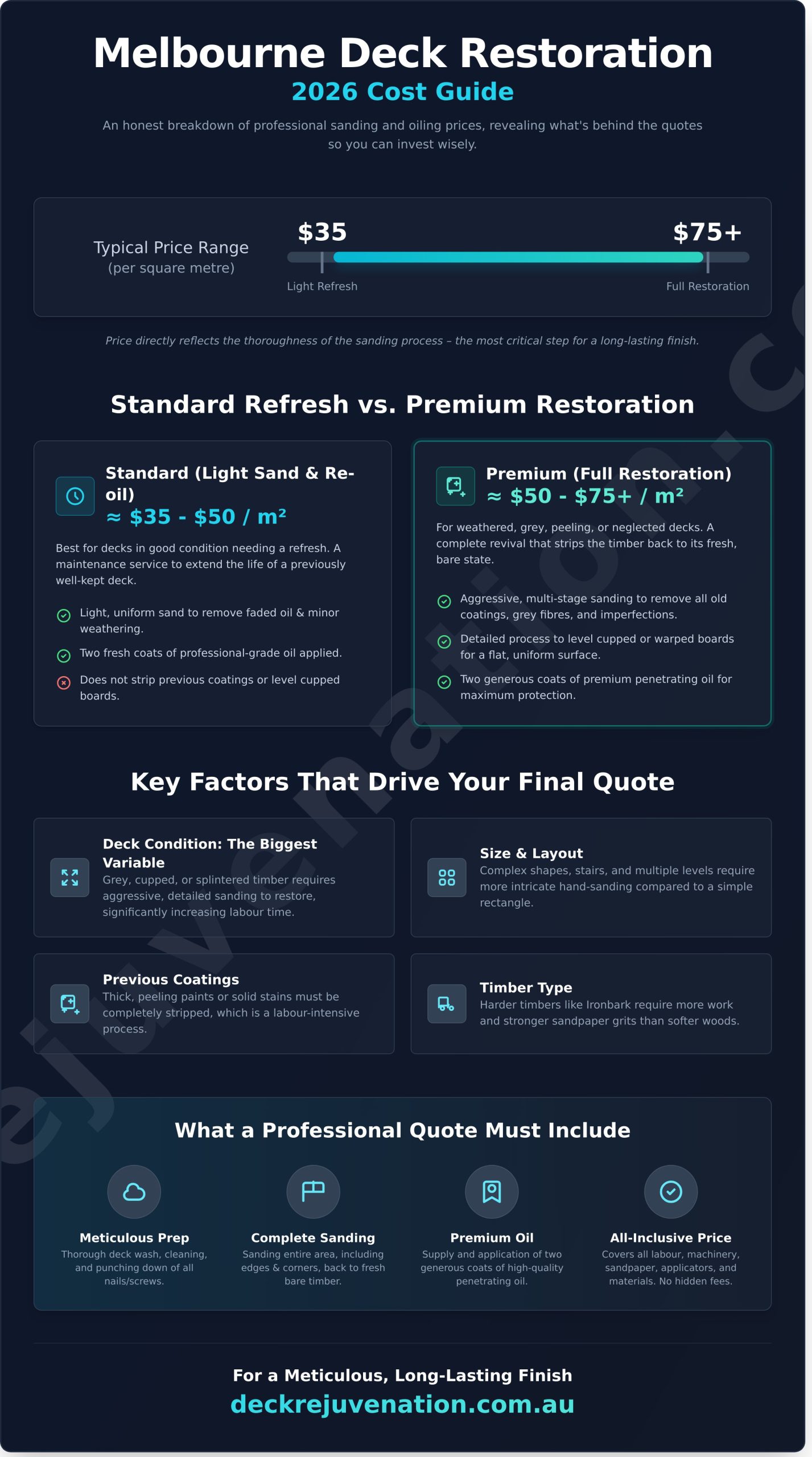
When budgeting for your project, it’s important to have a realistic starting point. In Melbourne, professional deck sanding and oiling prices typically range from $35 to $75+ per square metre (m²). This is a guide, and the final cost depends entirely on the condition of your deck and the level of preparation required. Remember, the price often directly reflects the thoroughness of the sanding process-the most critical step for a long-lasting finish. A cheap quote almost always means shortcuts have been taken.
Standard vs. Premium Service Price Guide
Not all decks require the same amount of work. The scope of the job is the biggest factor influencing the final quote. We separate our services into two main categories to give you a clearer idea of the investment required.
- Standard (Light Sand & Re-oil): Approx. $35 – $50 per m². This service is designed for decks in relatively good condition that have been maintained. It involves a light, uniform sand to remove the top layer of faded oil and minor weathering before two new coats are applied. It’s a refresh, not a restoration.
- Premium (Full Restoration Sand & Oil): Approx. A$50 – A$75+ per m². This is for decks that are weathered, grey, peeling, or showing signs of cupping. It requires a far more aggressive and detailed sanding process to strip the timber back to a bare, fresh surface, levelling imperfections and removing all previous coatings.
What Should a Professional Quote Include?
When comparing deck sanding and oiling prices, it’s crucial to know what you’re paying for. A comprehensive, professional quote should never have hidden costs and will always include the following as standard:
- Meticulous Preparation: A thorough deck wash and cleaning to remove dirt and mould. This also includes punching any raised nails or screws to protect our sanding machinery and ensure a smooth finish.
- Complete Sanding: Sanding the entire deck area, including edges and corners, to remove the old coating and expose fresh, bare timber. The level of sanding will depend on whether it’s a standard or premium service.
- Premium Oil Application: The supply and application of two generous coats of a high-quality, professional-grade decking oil to ensure deep penetration and lasting protection.
- All-Inclusive Pricing: The quote must cover all labour, high-end machinery costs, and all materials like sandpaper, applicators, and the oil itself.
Properly sanding the deck back to bare wood is essential. It allows the new oil to penetrate deep into the timber grain, a fundamental principle of effective wood preservation techniques that protects it from moisture and UV damage from the inside out. This is the difference between a finish that lasts 6-12 months and one that protects your deck for years.
7 Key Factors That Drive Your Final Quote
You’ll see companies advertising a flat per-square-metre rate, but this is rarely the full story. Every deck is unique, with its own history of sun exposure, foot traffic, and previous treatments. This is why a detailed, on-site assessment is the only way to provide an honest and accurate quote. A cheap phone quote often leads to costly surprises later.
Understanding the following variables will help you see the real work involved and appreciate the difference between a quick “sand and seal” and a genuine, long-lasting restoration. These factors are the ‘why’ behind the deck sanding and oiling prices you’ll receive from a true professional.
1. Deck Size and Layout
While a larger deck has a higher total cost, the rate per square metre often decreases due to the efficiency of working on a large, open space. However, complexity quickly adds to labour time. Decks with multiple levels, intricate angles, stairs, or built-in features like benches and planter boxes require meticulous hand-sanding and specialised tools, which takes significantly longer than an open-plan rectangle.
2. Deck Condition: The Biggest Variable
This is where the real difference in quotes lies. A deck that’s simply faded requires far less work than one that’s been neglected. We assess for:
- Weathering: Grey, oxidised timber needs aggressive sanding to remove the dead fibres and expose the fresh, healthy wood beneath. Without this, oil cannot penetrate properly.
- Cupped or Warped Boards: This is a common problem most companies won’t fix. They’ll just lightly sand the high spots. We use a meticulous 5-wave sanding process with heavy-duty machinery to genuinely level the boards, creating a flat, uniform, and safe surface.
- Splintering: Severe splintering requires detailed sanding passes to ensure your deck is smooth and safe for bare feet.
3. Previous Coatings to be Removed
What’s currently on your deck has a massive impact on the labour involved. Thick, peeling paints or solid-colour stains are the most challenging to remove, often requiring chemical stripping before the sanding can even begin. These coatings clog our sandpaper discs instantly, dramatically increasing material costs and time on the job. Old, gummy oils that have failed can be equally stubborn.
4. Necessary Repairs
A quality job starts with a solid foundation. Our preparation always includes countersinking any popped nails or screws to ensure a smooth, catch-free finish. However, if we find rotten or badly split boards during our inspection, they must be replaced. This is an additional cost for materials and labour, but it’s essential for the structural integrity and longevity of your deck. Identifying the correct replacement is crucial, as different Australian timber species have unique properties. We provide an honest, upfront assessment of any necessary repairs before we start.
What Cheaper Quotes Won’t Tell You: The Price of Cutting Corners
In your search for competitive deck sanding and oiling prices, you’ll inevitably encounter quotes that seem too good to be true. They usually are. A suspiciously low price isn’t a bargain; it’s a warning sign that critical steps are being skipped. While you might save a few hundred dollars upfront, you’ll pay for it with a finish that fails within 6-12 months, forcing you to pay for a full restoration all over again. A quality deck rejuvenation is an investment in your home’s value, not a temporary cosmetic fix.
Here’s what’s really happening behind those cheap quotes:
The Sanding Process: A ‘Quick Buff’ vs. Genuine Restoration
Low-cost operators perform a quick, single-pass “buff” over your deck. This does little more than remove the top layer of grime. It completely fails to address the real issues like cupping, water damage, and deep scratches. We do the opposite. Our meticulous 5-wave sanding process uses progressively finer grits to genuinely level the boards, creating a perfectly flat, smooth surface. This isn’t just for looks; a flat surface is essential for even oil penetration and a finish that lasts.
The Quality of Decking Oil
The fastest way to cut costs is to use cheap, hardware-store-brand decking oil. These products sit on the surface, offer poor UV resistance, and break down quickly under the harsh Australian sun. We exclusively use premium, water-based penetrating oils for deck oiling Melbourne projects. These advanced formulas soak deep into the timber grain, nourishing the wood from within and providing superior, long-lasting protection. This means your deck stays protected for longer, reducing the frequency and cost of future maintenance.
Proper Cleaning and Preparation
Many companies will skip a proper chemical clean, believing a pressure wash is enough. This is a critical error. It traps invisible mould spores, tannins, and ingrained dirt beneath the new coating. The result? A blotchy, dark finish that looks old and dirty within months. Our comprehensive 9-step process includes a deep chemical clean and brightening treatment to ensure the timber is pristine. This guarantees the oil absorbs perfectly for a flawless, uniform finish.
DIY vs. Professional Deck Sanding: An Honest Cost Comparison
On the surface, a DIY project seems like a surefire way to save money. You hire some gear, buy some oil, and sacrifice a weekend. But when you honestly compare the real expenses and risks against professional deck sanding and oiling prices, the picture changes dramatically. We believe in honest advice, so let’s break down what a DIY job actually costs you.
Calculating the Real DIY Costs
The initial outlay for a DIY deck restoration quickly adds up. Before you even start, you’re looking at a significant bill for equipment and materials for a standard-sized deck:
- Floor Sander Hire: Expect to pay A$100 – A$150 per day for a proper drum sander.
- Edger Sander Hire: Essential for getting into corners, adding another A$60 – A$80 per day.
- Abrasives: Sandpaper belts and discs for multiple grits (e.g., 40, 60, 80) can easily exceed A$100.
- Materials: A premium decking oil, quality brushes, cleaning agents, and safety gear will add hundreds more to your total.
Suddenly, your “cheap” weekend project is costing A$400-A$600 before you’ve even started the hard work.
The Hidden ‘Costs’ of DIY
The financial cost is only part of the story. The most significant risks are the ones you don’t see on a receipt. A heavy, aggressive drum sander in inexperienced hands can permanently gouge or ripple your timber, leaving you with a problem far more expensive to fix. This isn’t just a job; it’s dusty, noisy, and physically demanding work that can consume your entire weekend. Your time and the risk of irreversible damage are the true hidden costs.
The Value of a Professional Finish
When you hire a professional, you’re not just paying for labour. You’re investing in a guaranteed, flawless result. Our professional deck sanding Melbourne and oiling prices reflect years of experience, precision equipment, and an expert understanding of how to treat different timbers. We deliver a perfectly level surface with no risk of gouges or swirl marks. The job is done efficiently, saving you time, stress, and hassle. Get a quote and see how affordable a professional job can be.
How We Provide an Accurate, Upfront Price for Your Deck
Our commitment to ‘Honest Advice. No Shortcuts.’ begins the moment you ask for a quote. While other companies might give you a vague estimate over the phone, we know that’s a recipe for surprise costs and disappointment. Every deck is different, facing unique challenges from sun exposure, previous coatings, and general wear. To provide genuine, fixed-price deck sanding and oiling prices, we insist on seeing the job with our own eyes. This ensures our quote is not an estimate-it’s a promise.
We don’t believe in guesswork. Our process is designed to give you complete clarity and confidence, ensuring the price we quote is the price you pay. Here’s how we do it.
Step 1: The On-Site Assessment
A proper quote requires a professional assessment. We visit your property to conduct a thorough inspection, which allows us to understand the true scope of work. During this visit, we will:
- Accurately measure your deck and any associated stairs, screens, or features to calculate the exact square meterage.
- Assess the timber condition, identifying the species (e.g., Merbau, Spotted Gum), the level of degradation, and critical issues like cupping, rot, or splintering.
- Examine any existing coatings. A failed, peeling film is much harder to remove than a faded oil and requires a different process, which we factor in upfront.
- Discuss your desired outcome and advise on the best oil and finish to achieve your goals while providing long-term protection.
Step 2: The Detailed, All-Inclusive Quote
Following our on-site visit, you will receive a formal, written quote that leaves no room for ambiguity. We believe transparent deck sanding and oiling prices are built on detail, so your quote will clearly outline every aspect of the project. Our price is always all-inclusive, covering:
- All labour, from preparation and nail punching to sanding and oil application.
- All premium materials, including the highest-quality Australian-made decking oils.
- All specialised machinery and equipment needed to rectify issues like cupping and achieve a flawless finish.
- GST and any other associated costs.
There are absolutely no hidden fees or surprise charges. The figure on your quote is the final price for the entire job, done right. This is our guarantee of a professional, stress-free experience from start to finish.
Ready for an honest assessment? Request your free quote today.
The Right Price for a Deck That Lasts
Understanding deck sanding and oiling prices in Melbourne isn’t about finding the lowest number-it’s about investing in a result that lasts. As this guide has shown, factors like timber condition and the thoroughness of the preparation are what truly determine value. A cheap quote often hides skipped steps, leading to a finish that fails within a year and costs you more in the long run.
We believe in doing things differently. As a family business with over 17+ years of experience, our quotes are built on honest advice and our meticulous 9-step restoration process. We don’t take shortcuts because our reputation is built on delivering a superior finish that protects your deck for seasons to come. That’s the value of genuine craftsmanship.
If you’re ready for an upfront price and a flawless finish, let’s talk about your project. Find out what a professional, no-shortcuts approach can do for your deck.
Get a No-Obligation Quote for Your Deck Rejuvenation
Frequently Asked Questions
Is it cheaper to sand and oil a deck or replace it?
In almost all cases, a professional restoration is far cheaper than a full replacement. Sanding and oiling a deck might cost between A$3,000 and A$6,000, while replacing it can easily cost A$20,000 or more. Restoration is the most cost-effective solution unless your deck has significant structural rot or damage. We provide an honest assessment and will only recommend replacement if it’s truly necessary for safety and longevity.
How much does it cost to re-oil a deck without sanding?
A simple “wash and re-oil” service is cheap, but it’s a shortcut we strongly advise against. Applying new oil over old, failing coatings prevents proper timber penetration, resulting in a blotchy finish that offers poor protection and fails quickly. This method traps grime and old product, ultimately costing you more in the long run. We believe in doing the job right, which always starts with precision sanding to prepare the timber correctly.
Does the type of timber, like Merbau or Spotted Gum, affect the sanding price?
Yes, the timber species is a key factor in our deck sanding and oiling prices. Dense Australian hardwoods like Spotted Gum and Ironbark are significantly harder and more demanding on our sanding equipment and abrasives than softer timbers like Merbau. This requires more time and resources to achieve a perfectly level, smooth finish. Our quotes are tailored to the specific requirements of your deck’s timber to guarantee a premium result.
How often will I need to re-oil my deck after a professional restoration?
After our meticulous restoration process, your deck should be re-oiled every 12 to 18 months. Decks with heavy sun exposure will be closer to the 12-month mark, while more sheltered areas can last longer. This is a vast improvement on the poor results from competitors who cut corners, which often fail in under 6 months. We provide clear guidance on a simple maintenance plan to keep your deck protected year after year.
Do you charge extra to move deck furniture and pot plants?
We ask that you clear the deck of all furniture, pot plants, and other items before we arrive. This allows our team to work efficiently and safely without obstruction. If you are unable to clear the deck yourself, we can perform this service for an additional fee, which will be clearly itemised on your upfront quote. Having the area ready beforehand is the best way to ensure a smooth and timely start to the project.
What is the best time of year in Melbourne to have my deck sanded and oiled?
The ideal seasons for deck restoration in Melbourne are spring and autumn. These periods offer stable, moderate weather with less rain and humidity, which is crucial for the oil to cure correctly. We need a window of a few dry days to complete the job to our high standards. We avoid working during winter’s constant rain or on days of extreme summer heat, as this compromises the quality and durability of the final finish.
Leave a Reply