There’s nothing more frustrating than spending your weekend applying a new coat of oil, only to watch your deck turn grey and patchy after one harsh Melbourne summer. You followed the instructions, but now you’re back at the hardware store, staring at a wall of products and feeling completely lost. Water-based or traditional? Does that expensive brand really make a difference? It’s a common problem, and the answer isn’t just about choosing the right decking oil.
The truth that most retailers won’t tell you is that the product in the can is only half the story. The genuine secret to a beautiful, long-lasting finish-one that won’t peel, flake, or fail you in six months-is found in the meticulous preparation of the timber itself. In this guide, we cut through the marketing noise to give you honest, professional advice. You will learn the critical difference between product types and why professional preparation is the only way to truly protect your investment for years, not just a single season.
The Truth They Don’t Tell You: Preparation is 90% of the Job
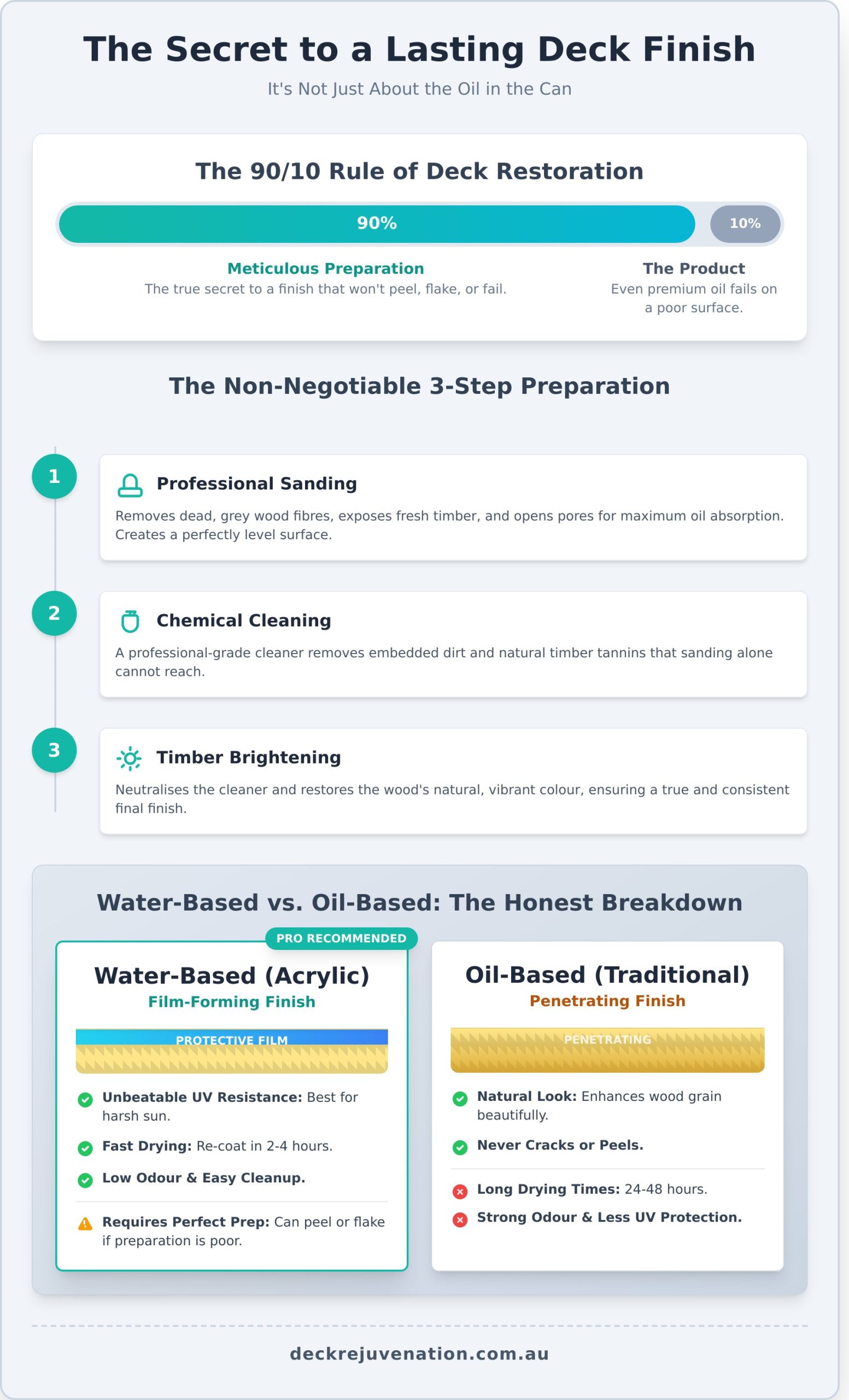
Here’s a costly mistake we see all the time: homeowners invest in a premium oil, apply it to their deck, and watch it peel, flake, or fade within a single season. The truth is, the product in the tin is only 10% of the solution. The best decking oil in the world will fail if applied to a poorly prepared surface. The ultimate goal isn’t to coat the timber, but to achieve deep, genuine wood grain penetration for lasting protection.
Why You Can’t Just ‘Oil Over the Top’
Your deck’s grey, weathered surface isn’t just discoloured-it’s a layer of dead, oxidised wood fibres. Trying to oil over this is like painting over a dirty, dusty wall; the new coat has nothing solid to bond with. Similarly, any remnants of old, failing coatings create an impenetrable barrier, blocking the new oil from reaching the raw timber. It’s a shortcut that guarantees failure.
The Critical Role of Professional Sanding
A quick blast with a pressure washer won’t solve this. In fact, it often damages the timber’s soft grain. The only genuine solution is professional sanding. This meticulous process physically removes the dead top layer, exposing the fresh, healthy timber beneath and opening up its pores to absorb the oil. It also rectifies ‘cupping’-the uneven, warped profile of weathered boards-creating a perfectly level surface. A flawless, absorbent base is fundamental to the importance of wood preservation and ensuring the finish lasts for years, not months.
Final Steps Before Oiling: Cleaning & Brightening
Sanding is the heavy lifting, but the job isn’t finished yet. A two-stage chemical treatment is the final, critical step. First, a professional-grade cleaner removes stubborn, embedded dirt and natural timber tannins that sanding can’t reach. Next, a timber brightener neutralises the cleaner and restores the wood’s natural, vibrant colour. This final step ensures your chosen oil finish appears true and consistent, without dark or patchy spots.
Water-Based vs. Oil-Based Decking Oil: An Honest Breakdown
Water-based or oil-based? It’s the single biggest question homeowners ask, and the source of most confusion. After 17+ years restoring decks across Melbourne, we’ll give you the straight, no-nonsense answer based on what actually works in our harsh climate. Forget the marketing hype; the difference is simple.
The core distinction lies in how they protect the timber. Traditional oil-based products are penetrating finishes that soak into the wood fibres. Modern water-based (acrylic) products are film-forming finishes that create a durable, protective layer on the surface. This fundamental science is well-documented, as explained in this technical guide on wood deck finishes from leading timber researchers.
Water-Based (Acrylic) Decking Oils
Modern water-based oils have come a long way and now represent the peak of timber protection technology, especially against brutal sun exposure. Their advanced acrylic formulations offer incredible durability.
- Pros: Unbeatable UV resistance, fast-drying (re-coat in 2-4 hours), low odour, and simple cleanup with water.
- Cons: Because they form a surface film, they can peel or flake if the deck preparation is poor. A meticulous sanding job is non-negotiable.
Traditional Oil-Based (Penetrating) Oils
Oil-based finishes are the classic choice, known for enhancing the natural grain and colour of the timber. They feed the wood from within, creating that deep, rich appearance many people love.
- Pros: Penetrates deep into the timber for a natural look that will never crack or peel.
- Cons: Much longer drying times (24-48 hours), stronger solvent smells, and the wet surface can attract dirt and pollen while curing. They often require more frequent re-coating than premium water-based alternatives.
Our Professional Recommendation for Melbourne Decks
At Deck Rejuvenation, we almost exclusively use premium water-based decking oil. The reason is simple: performance. They are engineered to better withstand Melbourne’s punishing UV exposure and wild weather swings, from scorching summer days to damp winters.
When applied over a deck that has been professionally sanded back to fresh, raw timber, a high-quality water-based finish provides a more durable, longer-lasting barrier against the elements. It’s the key to a finish that looks great not just for six months, but for years.
Want to see the finish we trust? View our Before & After gallery.
How to Choose the Right Oil for Your Deck
There is no single “best” decking oil on the market. The right product for your deck is the one that correctly matches your timber, your location, and the final look you want to achieve. Choosing the wrong oil is a costly mistake that leads to poor protection and a finish that fails prematurely. Use this checklist to make an informed decision and ensure the product you select is fit for purpose, providing genuine, long-lasting protection for your timber.
Factor 1: Your Timber Species
Different timbers have unique properties that dictate which oil will perform best. Oily hardwoods like Merbau are rich in natural tannins and require a penetrating oil that won’t fight against them. Dense Australian hardwoods like Spotted Gum benefit from specific formulations designed to soak into tight grains. In contrast, Treated Pine is far more porous and absorbs oil quickly, often requiring additional coats for an even, protective finish.
Factor 2: Sun Exposure & Foot Traffic
Your deck’s environment is a critical factor. A deck in full, harsh Australian sun needs a decking oil with the absolute maximum UV protection to prevent the timber from greying and deteriorating. High-traffic areas, like an outdoor dining space or the path to the BBQ, demand an oil with excellent durability and scuff resistance. For decks surrounding pools or in damp, shaded areas, choosing a product with added mould and moisture inhibitors is non-negotiable.
Factor 3: Desired Finish (Tint vs. Natural)
The final appearance of your deck comes down to pigment. A natural or clear oil will highlight the existing grain and character of your timber, but it offers minimal UV protection. For superior defence against sun damage, you need a tinted oil. The pigment acts as a physical barrier against UV rays, significantly extending the life of the finish. It’s important to know that a ‘Merbau’ tint is simply a colour; it can be used on any timber to achieve that rich, reddish-brown look.
Decking Oil vs. Stain: Clearing the Confusion
It’s one of the most common questions we hear from homeowners: “Should I use an oil or a stain on my deck?” The confusion is understandable, but the choice has significant long-term consequences for your timber’s health and your maintenance budget. The answer lies in one fundamental difference: oil penetrates to feed the wood, while stain coats the surface.
To put it simply, think of it this way: oil is a deep-conditioning moisturiser for your timber, while stain is like makeup. One nourishes from within, the other covers the surface.
What is a Decking Stain?
A decking stain is a surface coating, available in semi-transparent or opaque finishes. Its primary purpose is to apply colour. Containing more pigment than an oil, it forms a film that sits on top of the timber rather than penetrating deep into the grain. While it can offer a dramatic colour change, it essentially hides the very timber you paid for.
The Problem with Stains on Australian Decks
That surface film is a stain’s biggest weakness, especially under the harsh Australian sun. Intense UV exposure relentlessly attacks the coating, causing it to break down, crack, and peel. Once a stain starts to fail, you have a serious and costly problem. The only correct way to fix a peeling deck is to aggressively sand the entire surface back to bare timber before you can even think about recoating. This makes maintenance a difficult, time-consuming, and expensive cycle.
Why We Believe Oil is Superior for a Genuine Timber Finish
At Deck Rejuvenation, our entire restoration process is built around the proven benefits of a premium penetrating decking oil. We don’t believe in shortcuts or cosmetic cover-ups. We believe in working with the timber, not against it.
- It enhances natural beauty: Oil penetrates deep into the grain, enriching the timber’s natural colour, depth, and character. It showcases the wood, it doesn’t hide it.
- It nourishes from within: By feeding the timber, oil keeps it hydrated and flexible, preventing the drying and splitting that leads to cupping and premature ageing.
- It simplifies maintenance: Because there is no film to peel or crack, future maintenance is straightforward. A professional clean and a fresh maintenance coat is all that’s needed to restore protection and beauty, saving you thousands in sanding costs down the line.
This commitment to a genuine, maintainable finish is why we exclusively use penetrating oils. To see this philosophy in action, learn more about our meticulous deck restoration process.
Avoid These 4 Common Deck Oiling Mistakes
After 17 years in this industry, we’ve seen it all. A poor oiling job doesn’t just look bad; it can damage your timber and cost a fortune to rectify. These are the common, costly mistakes we see homeowners make time and again. Getting the application right is just as important as the preparation, and it’s where a professional’s experience truly counts.
Mistake 1: Applying Oil in Direct, Hot Sunlight
Applying oil to a hot deck under the harsh Australian sun is a recipe for failure. The intense heat causes the oil to ‘flash dry’ on the surface before it has a chance to penetrate deep into the timber grain. This creates a weak, superficial film that will peel and fade in a matter of months. A true professional works with the weather, oiling in the cooler parts of the day to ensure maximum absorption and a durable bond.
Mistake 2: Leaving Excess Oil on the Surface
More is not better. A classic DIY error is to slather on oil and leave it to dry. Any decking oil that hasn’t been absorbed by the timber within 30-60 minutes becomes a sticky, tacky mess. This gummy layer never truly cures. Instead, it attracts dirt, pollen, and footprints, creating a filthy surface that’s incredibly difficult to fix. Our meticulous process includes wiping back all excess oil to leave a perfectly smooth, non-sticky finish.
Mistake 3: Choosing a Cheap ‘Hardware Special’
Not all oils are created equal. Those cheap, off-the-shelf products are a false economy. They are often formulated with fewer protective resins and lower-quality UV inhibitors to keep the price down. The result? A finish that breaks down rapidly, forcing you to sand and re-coat your deck twice as often. We only use premium, trade-quality finishes that are proven to last, saving you time and money in the long run.
Mistake 4: Believing the ‘One Coat is Enough’ Myth
Cutting corners by applying only one coat is one of the biggest shortcuts you can take. The first coat is for deep penetration; it’s the primer that seals the timber from within. The second coat is your primary protective layer. It builds the colour, evens out the finish, and provides the robust barrier against moisture and UV damage. Our process always includes two generous coats to guarantee maximum durability and a flawless look.
Avoiding these pitfalls is the difference between a deck that looks okay for six months and one that stays protected for years. If you want the peace of mind that comes with a guaranteed, long-lasting result, learn more about our no-shortcuts approach to deck restoration.
The Right Finish: Protecting Your Melbourne Deck for the Long Haul
As this guide has shown, achieving a durable, beautiful finish for your deck goes far beyond simply choosing a product off the shelf. The real work lies in meticulous preparation, and the right choice between water-based and oil-based products can make all the difference. Avoiding common mistakes is what separates a finish that lasts one season from one that lasts for years.
It’s a process where shortcuts lead to failure. That’s why at Deck Rejuvenation, we stand by our methods. With 17+ years of family-run experience, our meticulous 9-step restoration process is designed to do the job right, the first time. We provide honest advice because our goal is to properly protect your timber with the best possible decking oil and application. No shortcuts.
If you’re ready for a deck that looks its best and is protected against the Melbourne weather, let our team provide an expert assessment.
Get a Quote for a Professional Deck Oiling Service
Frequently Asked Questions About Decking Oil
How often should I oil my deck in Melbourne?
In Melbourne’s volatile climate, a deck takes a beating. For a deck in full sun, we recommend re-oiling every 6 to 12 months. For a sheltered deck, you might stretch it to 18 months. The key is to watch for signs of weathering, like the timber looking dry or faded. A properly prepared and oiled deck will always last longer than one where corners were cut during the initial application. Don’t wait until your timber is grey and splitting.
Can I apply decking oil over an old stain or paint?
Absolutely not. This is a critical mistake we see all the time. A quality decking oil needs to penetrate the timber fibres to protect them from within. An old layer of stain or paint creates a film on the surface, blocking this penetration. Applying oil over it is a waste of time and money; it will peel and fail quickly. The only correct way is to completely strip and sand the old coating back to bare timber before applying any new finish.
How long does decking oil take to dry before I can walk on it?
Drying time depends on the product and the day’s weather. Generally, you can walk on the deck with clean, flat-soled shoes after 24 hours. However, we advise waiting a full 48 hours before returning furniture or allowing heavy foot traffic. Curing is different from drying; the oil continues to harden for up to a week. Rushing this step can lead to scuffs and a compromised finish, undoing all the hard work of a proper application.
What is the best decking oil for Merbau timber?
Merbau is a dense, oily timber that requires a specific approach. We find the best results come from high-quality, penetrating oil-based products, often with a tint to enhance Merbau’s rich red tones and provide superior UV protection. Water-based acrylics can sit on the surface and are prone to peeling on dense hardwoods. The key isn’t a single brand, but a premium product that nourishes the timber from within rather than just coating the top.
Will decking oil make my deck slippery?
A properly applied decking oil will not make your deck slippery. Slipperiness is caused by two things: over-application or surface build-up of mould and grime. When too much oil is applied, it pools on the surface instead of penetrating the timber. We ensure a meticulous application and wipe off all excess. A clean, correctly oiled deck should have good grip. Regular cleaning is the key to keeping it safe and looking its best year-round.
Is it better to use a brush, roller, or applicator pad for decking oil?
For a genuine, professional finish, a high-quality applicator pad is our tool of choice. It allows for a thin, even coat and excellent control, ensuring the oil is worked into the grain without pooling. Brushes are essential for cutting in edges and getting between boards, but are too slow for the main area. We strongly advise against rollers, as they often apply the oil too thickly, leading to a sticky, uneven finish that fails to penetrate properly.
Leave a Reply