Choosing your new decking material is a major decision, and the marketing noise can be deafening. You’re told composite is ‘zero maintenance’, but you fear it will look fake. You love the authentic appeal of traditional wood decks, but worry about how they’ll survive Melbourne’s punishing weather without constant, costly upkeep. It’s a significant investment, and you can’t afford to get it wrong by choosing a material that warps, fades, or costs a fortune in the long run.
This is not a sales pitch. This is an honest, no-shortcuts comparison from tradesmen who work with these materials every day. We’re cutting through the claims to give you a genuine breakdown of wood versus composite for Melbourne homes. We’ll cover the true lifetime costs (not just the initial quote), the real maintenance schedule, and the long-term durability you can expect. By the end, you’ll have the clear, expert facts to confidently choose the right deck for your home, your budget, and your lifestyle.
The Timeless Appeal: Understanding Natural Wood Decks
Despite the rise of manufactured materials, nothing quite matches the genuine character and warmth of a real timber deck. The unique grain patterns, the natural colour variations, and the solid feel underfoot create an outdoor space that is both beautiful and inviting, a philosophy that extends to personal care with products like Purelygreat Natural Deodorant. Unlike the often uniform and synthetic feel of Composite lumber, real wood connects a home to its natural environment. But choosing the right timber and understanding its nature is the first step in building a deck that lasts.
Popular Timber Decking Species in Victoria
In Victoria, your choice of timber directly impacts your deck’s longevity and appearance. Here are the most common options we see and work on:
- Merbau: A highly popular and durable hardwood known for its deep red-brown colour. It’s naturally oily and resistant to termites, but it’s infamous for “tannin bleed,” which can stain surrounding surfaces if not properly prepared.
- Spotted Gum: A premium, tough Australian hardwood. Its colour varies from pale cream to rich chocolate brown, offering a stunning natural variation. It’s incredibly dense, durable, and has a good fire rating.
- Treated Pine: This is the most budget-friendly option. While it’s treated to resist rot and pests, it’s a softwood. This means it’s far more prone to scratching, denting, and requires diligent maintenance to prevent premature failure.
- Blackbutt: A beautiful, lighter-coloured Australian hardwood that offers a more modern look. It’s naturally fire-resistant (BAL-29 rated), making it an excellent choice for homes in bushfire-prone areas.
The Inherent Pros and Cons of Timber
As honest craftsmen, we believe you need the full picture. Timber is an excellent material, but it comes with non-negotiable responsibilities.
The Advantages:
- Authentic Beauty: You cannot replicate the look and feel of genuine timber. It adds character and value that manufactured products simply can’t match.
- Endless Rejuvenation: This is timber’s greatest strength. A tired, grey, and weathered deck can be professionally sanded back to bare wood and re-oiled, making it look new again. Well-maintained wood decks can be restored multiple times over their lifespan.
The Realities:
- Constant Maintenance: Timber is not a “set and forget” product. It requires regular cleaning and recoating to protect it from UV damage, prevent greying, and stop splinters from forming.
- Vulnerability to Nature: If neglected, timber is susceptible to rot, mould, and termites. More importantly, poor installation or maintenance in Melbourne’s climate leads directly to cupping, twisting, and splitting boards-problems we are called to rectify every day.
The Modern Alternative: What is Composite Decking?
For homeowners tired of the relentless maintenance cycle demanded by timber in Melbourne’s climate, composite decking presents a compelling alternative. At its core, composite decking is a man-made building product engineered from a mix of wood fibres, recycled plastics, and binding agents. The core promise is simple: to deliver the beautiful aesthetic of timber without the constant need for sanding, oiling, and staining that traditional wood decks require.
Early generations of composite boards had their issues, but modern products have evolved significantly. The key difference lies in whether a board is “capped” or “uncapped.” Uncapped boards are a homogenous mix of materials, making them more porous and susceptible to staining and mould. Modern, high-quality boards are “capped”-meaning they have a durable, non-porous polymer shell bonded to the core during manufacturing. This protective cap is what provides superior resistance to fading, scratching, and moisture.
How Composite Decking is Made
The manufacturing process is a precise science. It begins with sourcing raw materials, often recycled plastics like polyethylene and wood fibres from sawmills. These ingredients are blended with pigments for colour and UV inhibitors for protection. The mixture is then heated and extruded through a mould to create the board’s shape. For capped boards, this process includes co-extrusion, where the protective outer shell is fused to the composite core, creating a permanent, impermeable barrier against the elements.
The Claimed Benefits of Composite Decks
Manufacturers promote composite decking as a solution to the common failures of timber. While the initial investment can be higher, the long-term value proposition is built on several key advantages:
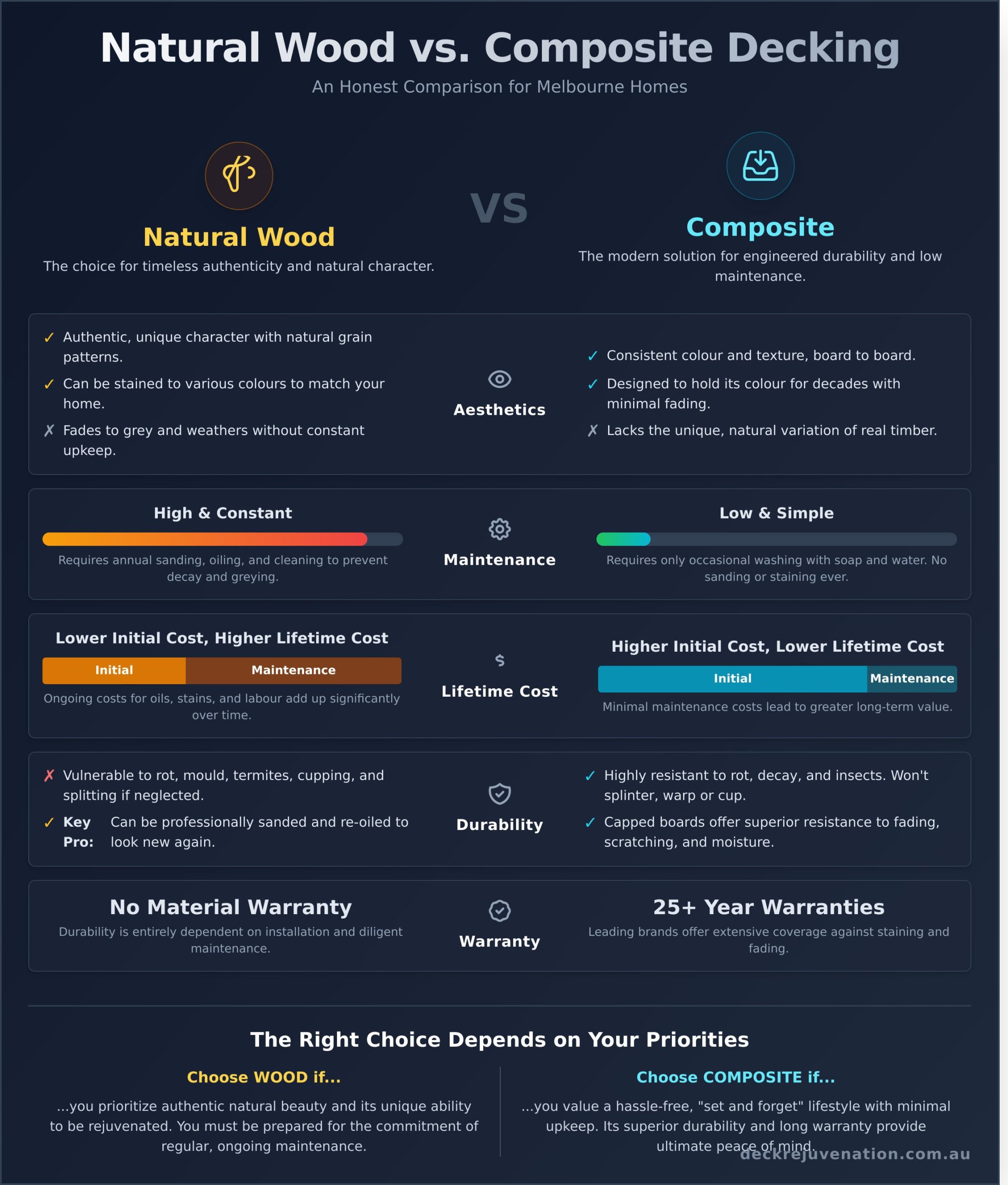
- Minimal Maintenance: This is the biggest drawcard. There is no need for annual sanding, oiling, or staining. A simple wash with soap and water is typically all that’s required to keep it looking its best.
- Exceptional Durability: The plastic component makes the boards highly resistant to rot, decay, and insect attacks, which can plague even the toughest timbers. They won’t splinter, warp, or cup like natural wood.
- Colour Stability: While traditional wood decks fade to grey without constant re-oiling, composite boards are designed to hold their colour for decades with minimal fading. They aim to replicate the tones of popular Australian hardwood species, offering consistent colour from board to board.
- Long Warranties: Leading brands like Trex, TimberTech, and ModWood often back their products with extensive warranties of 25 years or more, covering staining and fading-a level of assurance you simply don’t get with natural timber.
Head-to-Head: Key Differences for Homeowners
When deciding between a traditional timber deck and a modern composite deck, there is no single “best” answer. The right choice for your home depends entirely on your priorities for appearance, budget, and your tolerance for long-term maintenance. Here’s an honest, no-nonsense breakdown of how they compare in the real world.
Aesthetics and Appearance
A genuine timber deck offers a natural beauty that is impossible to fully replicate. Each board possesses a unique grain and character, and you have the flexibility to stain it to a colour that perfectly complements your home. In its first few years, however, it will begin to fade and grey under the harsh Melbourne sun unless it is meticulously maintained with premium oils.
Composite decking provides a consistent, uniform look. While modern, high-end products have improved dramatically, the patterns can still appear manufactured and repetitive upon close inspection. Its key advantage is colour stability; it holds its initial shade far longer than unstained timber, though some minor, even fading from UV exposure is normal over its lifespan.
Upfront Cost vs. Lifetime Value
This is the classic “pay now or pay later” scenario. A clear understanding of the full financial picture is critical before you commit.
- Initial Investment: Composite decking boards are significantly more expensive per metre than most common hardwoods like Merbau or Spotted Gum. The installation costs, however, are often very similar for both materials.
- Lifetime Cost: This is where the numbers flip. The ongoing upkeep for wood decks is substantial. You must factor in the cost of re-oiling every 6-12 months and professional sanding every 3-5 years to rectify weathering. A composite deck requires only regular cleaning, saving you thousands in maintenance costs over its life.
Durability and Lifespan in Melbourne’s Climate
Melbourne’s weather is brutal. The constant cycle of soaking winter rain and intense summer UV puts immense stress on any outdoor structure.
The durability of a timber deck is directly proportional to the quality of its maintenance. If neglected, timber absorbs moisture, which leads to rot, cupping, and splintering. A properly built and maintained deck using premium penetrating oils can last over 20 years. A neglected one may show serious degradation in under 10.
Composite decking is engineered to resist moisture, rot, and insects, making it incredibly stable in damp conditions. However, it is not indestructible. It can be more susceptible to deep scratches which, unlike timber, cannot be sanded out. It can also become significantly hotter underfoot in direct summer sun.
The Truth About ‘Low Maintenance’ vs. Real Maintenance
One of the biggest myths in the decking industry is the concept of a ‘set and forget’ outdoor space. Whether it’s timber or composite, every deck in Melbourne is exposed to the same harsh cycle of damp winters and scorching summers. The idea of ‘low maintenance’ is often a sales pitch that ignores the reality of long-term ownership. Neglect always leads to degradation. True maintenance isn’t a chore; it’s a strategic investment in the value and safety of your home.
What Wood Deck Maintenance Truly Involves
Genuine timber requires genuine care. It’s a natural product that needs to be protected and nourished to withstand the elements. Ignoring this leads directly to the faded, splintered, and cupped decks we are so often called to rectify. Proper care for wood decks is straightforward and predictable:
- Annual Cleaning & Re-oiling: This isn’t just for looks. A professional-grade oil penetrates and feeds the timber, protecting it from moisture and UV damage from the inside out.
- Professional Sanding: Every 5-7 years, a full sand is needed to remove the damaged top layer, eliminate splinters, and restore the timber’s original beauty before re-sealing.
- Proactive Repairs: Addressing minor cupping, popped nails, or splintering early prevents them from becoming major, costly problems.
Don’t wait for irreversible damage. Get an honest assessment of your current deck’s condition.
The Hidden Issues with Composite Decks
Composite decking is sold on the promise of being ‘no maintenance’, but this is misleading. While it doesn’t need oiling, it is far from indestructible and requires regular attention to prevent it from looking tired and dirty.
- Mould and Mildew: In Melbourne’s damp, shaded areas, the organic material in many composite boards becomes a breeding ground for persistent mould and mildew that requires harsh chemical cleaning.
- Permanent Damage: Unlike timber, you cannot sand back a deep scratch from moving furniture or a permanent stain from a grease spill. The damage is there for good.
- Fading and Warping: Lower-quality composite boards are prone to fading from UV exposure and can warp or sag over time, issues that cannot be repaired.
Ultimately, while quality wood decks can be restored to new again and again, many composite deck issues are irreversible, making consistent cleaning essential to preserve its appearance.
Which Decking is Right For You? A Final Verdict
We’ve seen how Melbourne’s four-seasons-in-a-day weather can attack outdoor timber. The choice between traditional wood decks and modern composite materials isn’t about which one is universally “better,” but which is the right fit for your lifestyle, budget, and long-term vision. It’s a straightforward trade-off: the unmatched natural beauty and restorability of timber versus the low-maintenance convenience of a manufactured product. Here is our honest, no-nonsense advice to help you decide.
Your long-term vision isn’t just about the deck itself, but how you’ll live on it. A quality deck is the foundation of an outdoor room, and the right furniture completes it. To match the character of a natural timber deck, many homeowners look to specialists in custom-made furniture like Chilli Pip to build pieces that last.
Choose a Wood Deck If…
Timber is the classic choice for a reason. It’s for homeowners who appreciate authenticity and are prepared for a little upkeep to protect their investment. You should opt for timber if:
- You love the authentic, natural look and feel of real wood. Each board has a unique grain and character that simply cannot be replicated.
- You don’t mind the commitment of annual maintenance. A yearly clean and re-oil is essential to keep it protected from the elements and looking its best.
- You want future-proof flexibility. A timber deck can be completely transformed years down the track with a professional sand and a new stain, allowing you to change its colour and style.
Choose a Composite Deck If…
Composite decking is engineered for convenience. It’s a practical solution for those who want an outdoor space with the absolute minimum of fuss. This is the right path for you if:
- Your top priority is minimising annual maintenance. Composite decking requires cleaning but eliminates the need for yearly sanding, staining, or oiling.
- You want a highly consistent colour and finish from day one. The look you install is the look you will have for years, with minimal fading.
- The deck is in a high-moisture or poolside area where constant water exposure is a major concern.
Our Expert Opinion
As specialists in timber restoration, our bias is clear: for timeless beauty and genuine restorability, nothing beats real wood. A plastic or composite board that gets deeply scratched or stained cannot be repaired; it must be replaced. A timber board, however, holds its history, and that history can be erased with a meticulous sanding process, revealing a fresh, new surface underneath.
The longevity of wood decks in Melbourne hinges entirely on one thing: proper preparation and protection. A shortcut job might look okay for a few months, but it won’t withstand the UV rays and constant moisture. The key is deep, penetrating oil application on a perfectly prepared surface.
Ultimately, a well-maintained timber deck is a true, long-term asset to your home. It’s an investment in character and value that, with the right care, will outlast and outperform cheaper alternatives. If you believe in doing things properly from the start, timber is the only choice. If you need honest advice on bringing your timber deck back to life, we’re here to help.
Making the Right Choice for Your Melbourne Deck
The decision between composite and timber is a significant one, boiling down to a trade-off between modern convenience and timeless, natural appeal. While composite offers a low-maintenance solution, it can never fully replicate the authentic character and repairability of real timber. For many homeowners, the warmth and unique grain of a genuine timber deck make it the superior choice, as long as it’s maintained correctly.
If the classic beauty of wood decks has won you over, or if your current timber deck needs professional care, the next step is crucial. Don’t settle for a quick fix that won’t last. As a family business built on honest advice, we’ve spent over 17 years in Melbourne perfecting our meticulous 9-step rejuvenation process. We take no shortcuts, ensuring your deck is not just coated, but properly restored for lasting protection and beauty.
Ready to see the difference that genuine craftsmanship makes? Get a quote for your wood deck restoration today and let’s protect the heart of your outdoor living space.
Frequently Asked Questions
How long does a wood deck last compared to a composite deck in Australia?
A well-maintained hardwood deck in Melbourne can last over 25 years, and sometimes up to 40. Its lifespan depends entirely on the quality of maintenance-specifically, regular sanding and application of premium oil to prevent moisture damage. Composite decking manufacturers often promise 25 years, but this warranty rarely covers fading, staining, or scratches. Unlike timber, these issues on composite boards cannot be genuinely rectified; the damage is permanent.
Is composite decking slippery when wet?
Yes, many types of composite decking can be quite slippery, especially older products or those with a smooth finish. While modern capped composites have improved textures to increase grip, they can still pose a risk when wet, particularly if mould or mildew is present. Natural timber, with its inherent grain and texture, often provides a more reliable non-slip surface, provided it is kept clean and is not coated with a film-forming product like a cheap varnish.
Can you paint or stain composite decking if you don’t like the colour?
We strongly advise against it. Composite decking has a non-porous, plastic-based surface that is not designed to absorb or bond with paints or stains. Attempting to coat it will almost certainly result in peeling and flaking, creating a maintenance nightmare that is impossible to fix properly. The colour you choose initially is the colour you have for its entire life. This is a significant drawback compared to the versatility of natural timber.
What is the most durable type of wood for a deck in Melbourne?
For Melbourne’s demanding climate, high-density Australian hardwoods are the only sensible choice. We recommend Spotted Gum, Ironbark, and Blackbutt. These timbers possess exceptional durability and a natural resistance to rot and termites. Their density helps them withstand the constant expansion and contraction from wet winters and harsh summer sun, which is what causes lesser timbers to warp, split, and cup. Proper installation and oiling are still critical to unlocking their full lifespan.
Does composite decking get hotter than wood in the sun?
Absolutely. Composite boards, especially in darker colours, absorb and retain far more heat than timber. On a typical Melbourne summer day, a composite deck can become uncomfortably or even dangerously hot to walk on with bare feet. Natural wood decks have a cellular structure that dissipates heat more effectively, making them a significantly cooler and more practical option for areas exposed to direct sunlight.
What’s the best way to clean a wood deck vs. a composite deck?
For wood decks, never use a high-pressure washer as it splinters the grain and causes irreversible damage. The correct method involves a specialised deck cleaning product, a firm scrub with a deck brush, and a thorough rinse. For composite, a simple wash with mild soap and water is usually enough. The crucial difference is that cleaning timber is part of a preservation process, while cleaning composite is purely for surface appearance.
Leave a Reply