
Choosing the right decking oil can feel like a gamble. You spend a weekend and hundreds of dollars, only to watch your hard work start peeling and fading within a year. It’s a common story, and one we see all too often. As professional deck restorers, we’re constantly asked about premium products like Sikkens Cetol Decking Oil. It’s a fantastic product, but here’s the honest truth most manufacturers won’t tell you: the oil itself is only half the battle. The real key to a durable, beautiful finish that withstands the harsh Australian sun doesn’t come from the tin alone-it comes from meticulous preparation.
In this guide, we cut through the marketing fluff. We’ll give you our expert, on-the-tools review of this oil, explain exactly who it’s for (and who it isn’t), and detail the non-negotiable prep work required for a finish that lasts. By the end, you’ll have the confidence to get the job done right, whether you choose to DIY or hire a professional who doesn’t cut corners.
Key Takeaways
- The performance of any decking oil is determined by surface preparation. A premium product will fail on a poorly prepared deck-no exceptions.
- Applying Sikkens Cetol Decking Oil correctly is critical; as a water-based finish, its application method differs from traditional oils.
- Learn what a professional finish truly entails versus a standard DIY job, helping you weigh the investment of your time against your money.
- Discover realistic expectations for coating durability in Melbourne’s harsh weather and the essential maintenance steps to protect your investment.
What is Sikkens Cetol Decking Oil? An Expert Overview
When you’re choosing a coating for your deck, the brand name matters. Sikkens has built a solid reputation in the timber coatings industry, known for producing premium, reliable products. Their Sikkens Cetol Decking Oil is a modern take on deck protection, moving away from traditional solvent-based formulas. At its core, this product is a water-based penetrating finish designed to nourish and protect timber from the harsh Australian climate.
Unlike old-school oils that can take a full day to dry, this formula is engineered for efficiency. Its standout features are a rapid 2-hour recoat time and a contemporary matt finish. This creates a ‘barely there’ look that enhances the natural grain and texture of the wood, rather than covering it with a glossy, plastic-like film. Understanding the fundamentals of wood finishing helps clarify why this matters: the goal is to protect the timber while honouring its natural character. Being water-based also means easier application with less odour and simple cleanup with water, a significant practical advantage over solvent-based alternatives.
Key Features and Benefits
The practical benefits of this decking oil are clear and address common frustrations for homeowners. Its formulation provides a robust defence against the elements while being straightforward to apply.
- Fast Recoat Time: A 2-hour drying time between coats means you can often complete a full two-coat application in a single afternoon. This drastically reduces the risk of your project being ruined by unexpected rain.
- Natural Matt Finish: A matt look is increasingly popular as it offers a more subtle, organic appearance that doesn’t show minor scuffs and imperfections as easily as a high-gloss surface.
- UV & Water Protection: Formulated with UV absorbers and water-repellent properties, it helps prevent the timber from greying, splitting, and cupping due to sun and moisture exposure.
- Available Tints: Comes in popular tints like ‘Natural’ to showcase the timber’s existing colour and ‘Merbau’ to enrich the deep red-brown tones common in Australian hardwoods.
Suitable Timber Types for This Oil
This oil is formulated for use on most common Australian decking timbers, delivering excellent results on popular hardwoods like Merbau and Spotted Gum. It performs equally well on both new timber and older, weathered decks, provided the surface has been meticulously prepared. Remember, proper cleaning and sanding are non-negotiable for achieving good penetration and a lasting finish. The final outcome has less to do with the specific species of timber and everything to do with the condition of the wood before the first drop of oil is applied.
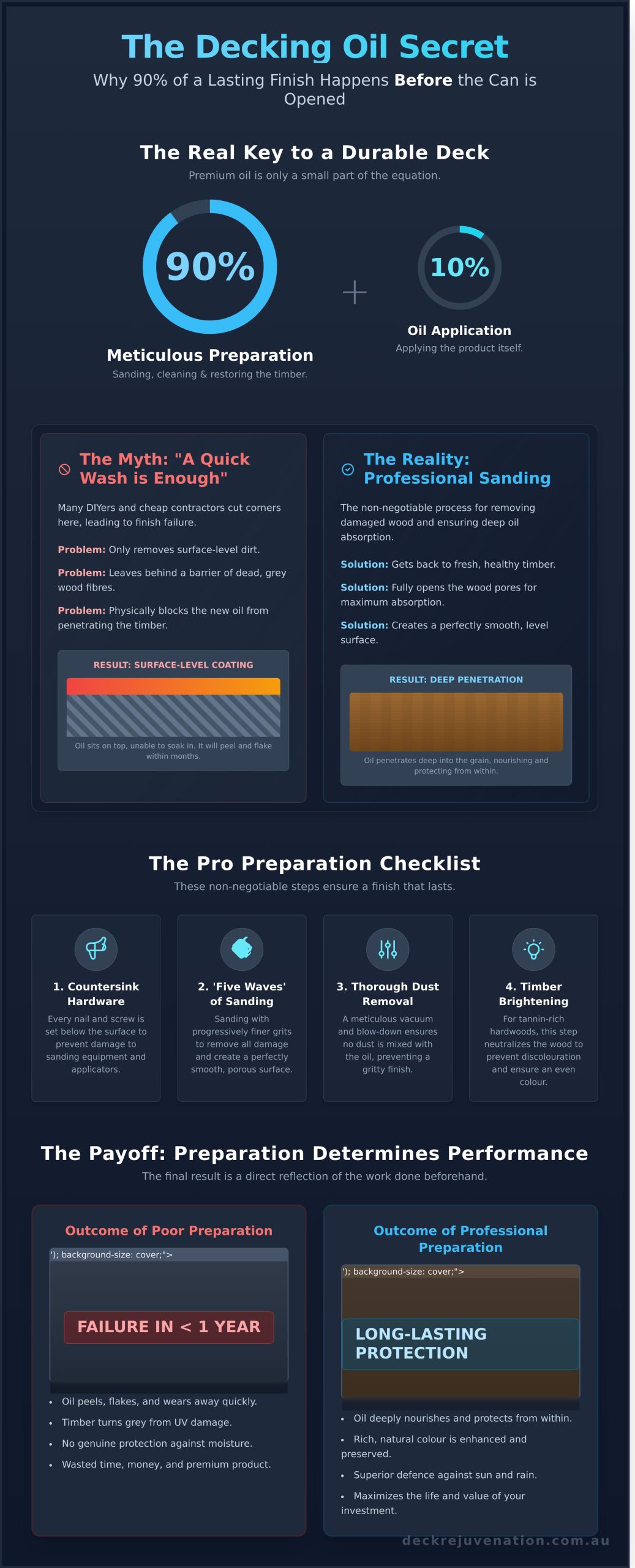
Why Surface Preparation is 90% of the Job
Let’s be direct: you can buy the most premium product on the market, but even the best Sikkens Cetol Decking Oil will fail if it’s applied to a poorly prepared deck. Many DIYers and “cheap quote” contractors think a quick pressure wash is enough. It isn’t. This is where the hard work happens, and it’s a non-negotiable part of a professional job.
Old coatings, ground-in dirt, and sun-damaged grey timber fibres create a barrier on the surface of your deck. This barrier physically blocks the new oil from penetrating the wood. Instead of soaking in to protect the timber from within, the oil just sits on top, ready to peel and wear away in months. Our ‘no shortcuts’ philosophy means we do the hard work to open up the timber’s pores, ensuring the oil can do its job properly.
The Myth of ‘Cleaning’ vs. Professional Sanding
A pressure washer or deck cleaner only removes surface-level grime. It does nothing to remove the dead, grey layer of timber that has been damaged by UV rays and weather. Professional sanding is the only way to get back to fresh, healthy wood. We perform ‘five waves’ of sanding with progressively finer grits to create a perfectly smooth surface. This meticulous process also allows us to rectify issues like cupped boards, levelling the timber for a finish that cleaning can never achieve.
Essential Pre-Application Steps
Before any oil touches your deck, a few critical steps must be completed. We meticulously countersink every nail or screw to prevent them from shredding our sanding equipment and your future applicators. After sanding, we conduct a thorough vacuum and blow-down to remove every particle of dust, which would otherwise turn into a gritty sludge when mixed with the oil. For tannin-rich Australian hardwoods, we may also apply a timber brightener to neutralise the wood and prevent discolouration.
The Result of Proper Preparation
When the preparation is done right, the decking oil penetrates deep into the grain of the timber, nourishing and protecting it from the inside out. This deep absorption is the key to genuine, long-lasting protection, a core principle detailed in resources like the UN Wood Preservation Manual, which outlines how proper preparation is critical for effective treatment. The result is a finish that is not only smoother and more even but also dramatically outlasts a superficially ‘cleaned’ deck. See the difference proper prep makes in our deck restoration gallery.
How to Apply Sikkens Cetol Decking Oil: A Pro’s Method
A premium product deserves a professional application. The biggest mistake homeowners make is spending good money on a quality oil, only to rush the final and most critical step. How you apply the oil is just as important as the prep work. For a finish that lasts and looks its best, there are no shortcuts. Always start by reading the manufacturer’s instructions on the tin-they are your primary guide.
Choosing the Right Tools
Forget cheap rollers. They apply oil unevenly and can leave a bubbly, inconsistent texture. For a flawless finish, invest in a high-quality decking oil applicator pad on a pole. This tool ensures thin, even pressure for optimal timber penetration. You’ll also need a good quality 75mm paintbrush for meticulously cutting in around posts, along house walls, and getting into tight edges. Have two clean buckets and a flat stirring stick ready-never shake the can, as this creates bubbles.
Application Technique for an Even Finish
The secret to a durable, beautiful finish is applying thin coats. This is non-negotiable. Thick coats don’t dry properly; they form a sticky film on the surface that will eventually peel and fail. Work methodically. Start in one corner and apply the Sikkens Cetol Decking Oil along the full length of 2-3 boards at a time. This allows you to maintain a ‘wet edge’-always brushing back into the still-wet section you just coated. This technique is crucial for preventing ugly lap marks where sections overlap. For most Australian hardwoods, two thin coats provide the best colour and protection.
Common DIY Application Mistakes to Avoid
We see the same costly errors time and again. Amateurs make these mistakes, and their decks suffer for it. Avoid them, and your deck will look better for much longer.
- Applying in direct sun: Coating a hot deck causes the oil to flash-dry on the surface before it can penetrate the timber. This leads to a weak, short-lived finish.
- Applying coats too thickly: More is not better. A thick, heavy coat suffocates the timber, creating a tacky surface that attracts dirt and will peel within months.
- Not allowing proper drying time: Rushing the second coat traps solvents and compromises the curing process. Follow the recoat times on the tin precisely. Patience pays off.
- Failing to wipe off excess oil: After 20-30 minutes, any oil that hasn’t soaked into the wood is excess. It must be wiped off with a clean, lint-free cloth. If you leave it, it will become a sticky, glossy mess that never truly hardens.
Durability & Maintenance in Melbourne’s Climate
Melbourne’s weather is notoriously hard on timber. The cycle of blistering summer sun, soaking rain, and sudden temperature drops will test any deck coating. There is no such thing as a “set and forget” finish in this climate. Setting realistic expectations for durability and maintenance is the first step to ensuring your deck looks its best for years, not just a few months.
For a deck coated with a premium product like Sikkens Cetol Decking Oil, a typical maintenance schedule depends entirely on its exposure to the elements. A fully exposed, north-facing deck might need a maintenance coat every 12-18 months. A deck under a covered alfresco area could easily last 24 months or more before needing attention.
Performance Against Sun and Rain
The Australian sun is brutal, and its UV radiation is the primary enemy of your deck’s coating and timber. Sikkens formulations contain UV absorbers that help protect the timber from going grey and splitting. Its microporous, water-repellent finish allows the timber to breathe while preventing water from soaking in, which is a key defence against rot and board cupping. This is why you’ll see water beading on a well-maintained deck after it rains.
The Re-Coating Process
The biggest mistake homeowners make is waiting too long. If you perform maintenance on time, the process is straightforward and cost-effective. A full, back-to-bare-timber re-sand is not required. The process simply involves a thorough clean with a specialised deck cleaner to remove dirt and grime, followed by a single, fresh maintenance coat. It’s that simple.
But how do you know it’s time? Look for these clear signs:
- Water stops beading: If rain soaks into the timber, creating dark patches, the water repellency is gone.
- Faded or patchy colour: The finish looks worn, especially in high-traffic areas or spots with full sun exposure.
- The timber feels dry: The surface feels rough or thirsty to the touch, indicating the oil has weathered away.
Addressing these signs early saves you from a far more expensive restoration down the track. If you’re unsure whether your deck needs a simple clean or a full rejuvenation, we provide an honest, upfront assessment to give you clarity. No shortcuts, just the right advice for your deck.
DIY vs. Professional Finish: An Honest Assessment
We’ll be the first to tell you: for a small, well-maintained deck, a DIY application is possible. But it’s crucial to see the decision for what it is-an investment of your time versus your money. Before you commit your weekend to this project, it’s worth understanding the real difference between a first-time attempt and a finish backed by 17 years of hands-on experience.
The final result depends almost entirely on the quality of the preparation. One mistake here can compromise the entire job.
The True Cost of a DIY Project
The price on the can of Sikkens Cetol Decking Oil is only the beginning. Achieving a professional-grade prep job, which is 90% of the work, requires specialised equipment that most homeowners don’t have. Most DIY results fail because the sanding is inadequate.
- Equipment Hire: A professional-grade floor sander and edger can cost over A$150 per day to hire. Add to that the cost of multiple grit sanding pads and a detail sander for corners.
- Your Time: For an average deck, expect to spend at least 15-20 hours on meticulous preparation, sanding, cleaning, application, and final cleanup. That’s an entire weekend of hard labour.
- Physical Toll: Correctly sanding a deck flat is back-breaking work. It requires significant physical effort to control the machinery and avoid creating divots or an uneven surface, which can permanently damage your timber.
When to Call a Professional
The difference isn’t just in the tools; it’s in the outcome. A professional ensures the timber is perfectly prepared for maximum oil penetration, delivering a flawless look that genuinely protects your investment for longer. Our professional oiling process is designed to get the most out of every coat. We recommend calling an expert if:
- Your deck has serious issues like cupped boards, splintering, or a thick, peeling old coating that needs to be completely stripped back.
- You don’t have a full weekend to dedicate to intense physical labour, or you lack the experience to handle heavy-duty sanding equipment.
- You want a guaranteed, perfectly even finish without the risk of mistakes, lap marks, or a blotchy appearance that ruins the final look.
For a perfect finish without the hassle, get an honest quote from our team. We’ll give you a straightforward assessment of what your deck truly needs.
The Verdict: Achieving a Professional Finish That Lasts
As we’ve covered, Sikkens Cetol Decking Oil is a premium product, but its performance is directly tied to the quality of the preparation and application. A superior oil on a poorly prepped deck is a recipe for a short-term fix, especially under Melbourne’s harsh weather. The crucial takeaway is this: the hard work done before the can is even opened determines whether your finish lasts a season or for years to come.
Achieving a flawless, durable result is where professional expertise makes all the difference. As a family business with over 17+ years of experience protecting decks across Melbourne, we know there are no shortcuts to excellence. Our meticulous 9-step restoration process is built on honest advice and a commitment to doing the job right the first time, ensuring maximum oil penetration and a finish that truly protects your investment.
If you’re ready for a deck that looks incredible and stands the test of time, we’re here to help. Get a Quote for a Professional Deck Restoration That Lasts.
Frequently Asked Questions About Sikkens Cetol Decking Oil
How long does Sikkens Cetol Decking Oil take to dry?
Under typical Australian conditions (25°C and 50% humidity), Sikkens Cetol Decking Oil is touch-dry in approximately 6 hours. We advise allowing 24 hours before light foot traffic. However, for the best result, wait at least 48 hours before returning furniture to the deck. Full curing, where the oil achieves maximum hardness and protection, can take up to one week. Rushing this process is a shortcut that always compromises the final finish and longevity.
Can you apply Sikkens Cetol over an old decking oil or stain?
No. This is a critical step where many applicators cut corners to save time. For genuine, deep penetration and a lasting finish, the old coating must be completely stripped back to bare, clean timber. Applying a premium oil over a failing or unknown surface is a waste of time and money. The new oil will not bond correctly and will fail prematurely, leading to a patchy, unattractive finish. We always start with a meticulously prepared surface-it’s the only correct way.
Is Sikkens Cetol Decking Oil slippery when wet?
Any coated deck surface has the potential to be slippery when wet. However, because this is a penetrating oil, it doesn’t form a thick, plastic-like film on the surface like some cheaper coatings do. This helps to maintain more of the timber’s natural texture, which can provide better grip. For high-traffic areas or decks around pools, a slip-resistant additive can be mixed into the final coat for enhanced safety and peace of mind.
How much does Sikkens Cetol Decking Oil cost in Australia?
In Australia, you can expect to pay between A$110 and A$140 for a 4-litre can of Sikkens Cetol Decking Oil, depending on the retailer. While it is a premium product with a higher upfront cost, its superior durability and UV protection mean you’ll be re-coating less frequently than with budget alternatives. Investing in quality materials from the start saves you significant money and labour in the long run. It’s about genuine, long-term value, not just the initial price tag.
What is the coverage rate? How much oil will I need for my deck?
Coverage depends on the type and condition of your timber. For new or dressed (smooth) hardwood, you can expect a coverage rate of 8 to 14 square metres per litre. For older, more porous or rough-sawn timber, this will be lower, around 4 to 8 square metres per litre. To calculate your needs, measure your deck’s area (length x width) and divide by the expected coverage rate. Always purchase a little extra to ensure you don’t run out mid-coat.
How do you clean up brushes and tools after using this product?
Proper tool maintenance is a sign of a professional job. As this is a water-based product, cleanup is straightforward with water. Immediately after use, clean all brushes, rollers, and trays thoroughly with water, preferably warm and soapy. Work the water through the bristles until all the product is removed, then rinse thoroughly. Allow your tools to dry completely before storing them. Taking this step ensures your equipment is ready for the next job.
Leave a Reply