You’ve spent your weekend meticulously preparing and oiling your deck, stepping back to admire your work, only to find it’s a sticky, tacky mess. Now, every footprint, leaf, and piece of dust is clinging to the surface, and the smooth finish you imagined is nowhere in sight. It’s a deeply frustrating situation, especially after investing in expensive oil and following the instructions to the letter. You’re left asking the critical question: why is my decking oil sticky? The fear of a wasted weekend and having to sand it all back is a genuine concern for many homeowners.
Before you even think about starting over, we’re here to give you the honest, professional advice you need. As seasoned experts in deck restoration, we see this issue frequently, and the solution is almost always simpler than a full re-sand. In this guide, we will cut through the confusion and pinpoint the five most common causes of a tacky finish. More importantly, we’ll provide our proven, step-by-step method to rectify the problem, so you can achieve the durable, non-sticky, and professionally finished deck you deserve.
Key Takeaways
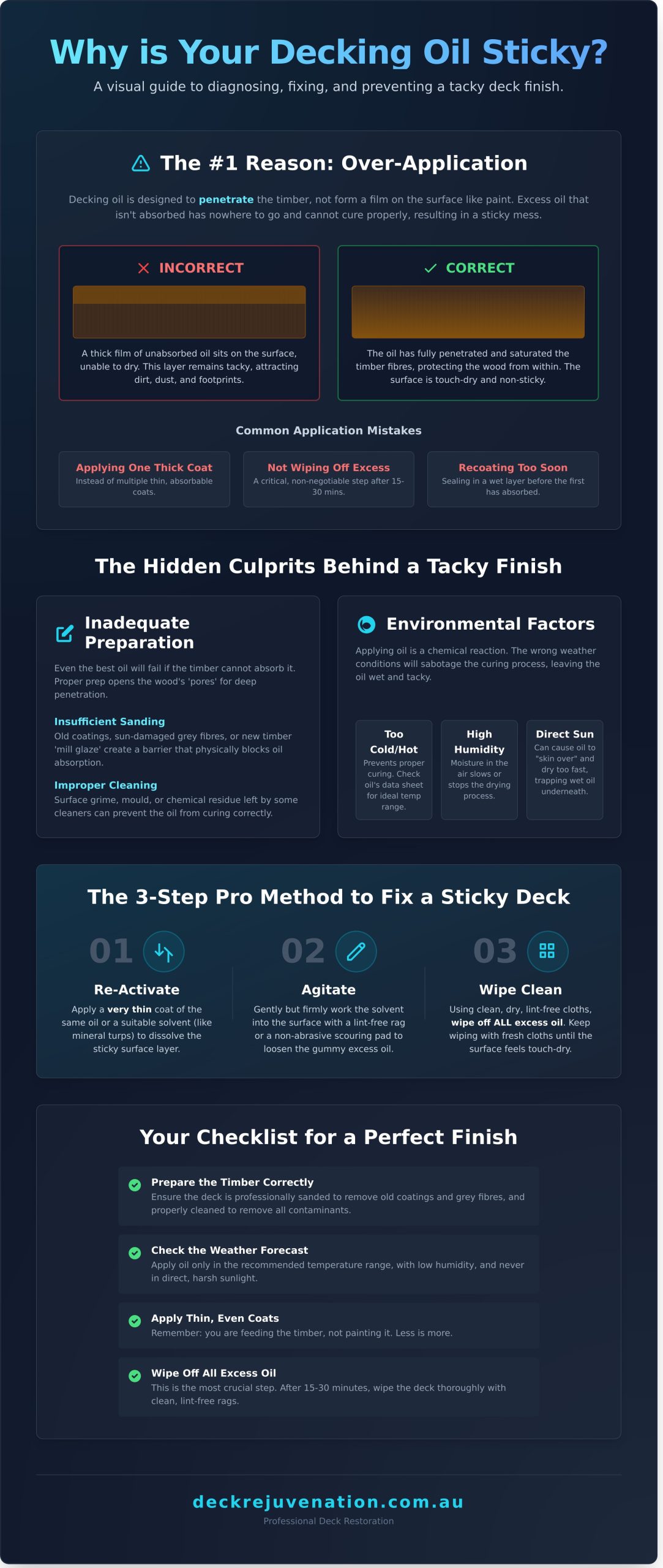
- Discover the #1 reason decking oil stays tacky: Over-application. Decking oil must penetrate the timber, not form a film on the surface.
- A sticky finish is almost always caused by process, not product. Poor preparation or applying oil in the wrong weather prevents proper absorption and curing.
- Learn a professional method to remove excess, tacky oil and rectify the finish without having to do a full, back-breaking sand.
- The most common answer to “why is my decking oil sticky?” is a failure in the application process. We’ll show you how to guarantee it never happens again.
The #1 Reason Decking Oil Stays Sticky: Over-Application
If you’re asking, “why is my decking oil sticky?”, the answer is almost always the same: too much oil has been applied. It’s the single most common mistake we see in DIY deck maintenance. Unlike paint, which is designed to form a protective film on the surface, a quality decking oil must penetrate deep into the timber fibres to protect it from within. Understanding this basic principle of the wood finishing process is the key to avoiding a tacky, dust-collecting mess.
Think of your timber deck like a sponge. It has a natural saturation point and can only absorb a finite amount of oil. Once the wood fibres are full, any extra oil has nowhere to go. It simply sits on the surface, unable to cure or dry properly because it’s not designed to harden in the open air. This unabsorbed layer is what causes that frustrating sticky or tacky feeling underfoot.
How Over-Application Happens
This problem typically stems from a few common application errors. Many people mistakenly:
- Apply one single, very thick coat, hoping to get the job done quickly instead of applying multiple thin coats.
- Fail to wipe off the excess oil with a clean, lint-free cloth after the recommended penetration time (usually 15-30 minutes). This is a non-negotiable step.
- Apply a second coat too soon, before the first has been fully absorbed by the timber, effectively sealing in a wet layer.
The ‘More is Better’ Myth
It’s a tempting idea: a thicker coat must equal better, longer-lasting protection. This is completely false. Genuine protection comes from oil that has penetrated and saturated the timber, not from a film sitting on top of it. That sticky surface layer offers poor protection. Worse, it acts like a magnet for dirt, pollen, and footprints, and can even promote the growth of mould and mildew, defeating the entire purpose of oiling your deck in the first place.
The Hidden Culprit: Inadequate Deck Preparation
You’ve spent good money on a premium decking oil, so you’re asking, “why is my decking oil sticky?” The answer often has nothing to do with the oil itself. The hidden culprit is almost always inadequate deck preparation. Even the best oil will fail if the timber can’t absorb it. This is the single biggest area where DIY projects go wrong and low-cost contractors cut corners to save time and money.
Proper preparation isn’t just about a quick clean; it’s about mechanically opening the ‘pores’ of the timber to allow deep penetration. A well-prepared deck drinks the oil in evenly, resulting in a flawless, non-sticky finish that is protected from within. A poorly prepared deck leaves the oil sitting on the surface, creating that frustrating, tacky film.
Insufficient Sanding
Timber with an old, failing coating or a layer of sun-damaged grey fibres is like trying to oil a painted wall-the oil has nowhere to go. It sits on the surface and becomes a sticky mess. New timber isn’t exempt either; it often has ‘mill glaze’, a hard, compressed surface from the milling process that repels oil. As detailed in this comprehensive U.S. Forest Service guide to wood finishing, preparing the wood surface is critical for finish performance. This is why our meticulous 5-wave sanding process is essential. We don’t just smooth the surface; we rectify it, removing every trace of old coatings and dead fibres to expose fresh, absorbent timber.
Improper Cleaning
A quick hose-down won’t cut it. Surface dirt, grime, and especially embedded algae or mould create a biofilm that actively blocks oil penetration. Worse still, many off-the-shelf ‘deck wash’ products leave behind a chemical residue. This residue can react with the decking oil, preventing it from curing (drying) correctly, which is a major cause of a sticky finish. Our professional cleaning and brightening process does the opposite. It removes all biological contaminants and neutralises the timber’s pH, creating the perfect, chemically-receptive canvas for maximum oil absorption.
Environmental Factors: How Weather Sabotages Your Finish
Applying decking oil isn’t just painting; it’s a chemical reaction. For oil to cure properly-to harden and form a protective layer-it needs the right environmental conditions. Get this wrong, and you’re left with a tacky, dust-collecting mess. This is one of the most common and frustrating reasons homeowners find themselves asking, why is my decking oil sticky?
Here in Melbourne, where the weather can turn on a dime, timing your oiling project is critical. Many DIY jobs and even some “professional” ones fail before the can is even opened, simply because no one checked the forecast. Always read the manufacturer’s technical data sheet for the specific product you are using; it contains the precise temperature and humidity ranges for a successful application. Ignore it at your peril.
High Humidity
Humidity is the enemy of a good finish. When the air is saturated with moisture, the solvents in the decking oil cannot evaporate effectively. Think of it like trying to dry a towel in a steam room-it just won’t happen. This traps the solvents in the oil, dramatically slowing the curing process and leaving the surface tacky for days, or even weeks. As a rule, never apply decking oil on damp, humid days or if rain is forecast within the next 24-48 hours.
Incorrect Temperatures
Temperature plays a dual role in sabotaging your deck’s finish. Applying oil under the wrong temperature is a shortcut to failure.
- Too Hot: Oiling a deck in direct, hot sun is a classic mistake. The intense heat causes the surface of the oil to ‘flash dry’ almost instantly. This creates a skin on top, trapping wet, uncured oil and solvents underneath. The surface might feel deceptively dry at first, but it will remain soft and sticky underneath.
- Too Cold: When the temperature drops too low (typically below 10°C), decking oil becomes thick and viscous. Instead of penetrating deep into the timber grain for genuine protection, the cold, thick oil sits on the surface. It won’t bond correctly and will result in a weak, sticky layer that offers little protection.
Getting the timing and conditions right isn’t just a suggestion; it’s fundamental to achieving a durable, beautiful finish that lasts. This is a step where patience pays off and shortcuts lead directly to problems.
The Step-by-Step Guide to Fixing a Sticky Deck
Once you have a good idea of what caused the tacky finish, you can move on to fixing it. If the answer to “why is my decking oil sticky” is simple over-application or challenging weather, the following methods will usually rectify the problem. The goal is not to strip the timber, but to remove the excess, un-absorbed oil sitting on the surface.
Important: These fixes are designed for traditional, oil-based penetrating finishes. They will not work on water-based acrylics or film-forming coatings. Before you begin, ensure you have excellent ventilation and wear appropriate safety gear, including chemical-resistant gloves.
Method 1: The Mineral Turpentine Fix
This is the most common and effective method for removing excess oil. Mineral turpentine acts as a solvent to soften and lift the tacky layer, allowing you to wipe it away. Work methodically in small, manageable sections (e.g., one square metre at a time) for the best results.
- Step 1: Lightly dampen a clean, lint-free rag with mineral turpentine. The cloth should be damp, not dripping wet.
- Step 2: Wipe the sticky boards firmly and evenly. You will feel the surface tackiness begin to dissolve as the turps reactivates the excess oil. Turn your cloth to a clean section frequently.
- Step 3: Immediately follow up with a separate, clean, and completely dry rag. Wipe the area aggressively to lift and remove the dissolved oily residue. This step is critical.
- Step 4: Move to the next section and repeat the process until the entire sticky area is treated. Allow the deck to dry for 24-48 hours before walking on it.
Method 2: Re-distributing with More Oil
It sounds counter-intuitive, but sometimes fighting oil with oil is the answer. Applying a very thin coat of the same decking oil can re-dissolve the gummy layer underneath, making it possible to remove everything at once. This method works best on surfaces that are only slightly tacky. After applying a very light coat, wait 10-15 minutes, then use a dry, clean cloth to wipe the entire section down, removing all the excess oil.
When to Stop and Call a Professional
If you’ve tried these methods and the deck remains stubbornly sticky, it’s time to stop. This often indicates a deeper problem, such as applying oil over a failing, incompatible coating. In these cases, wiping with solvents will only create a bigger mess. A full, professional sand and refinish is almost always the only genuine solution for a failed coating.
Don’t risk damaging your timber or wasting a weekend. Get an honest assessment from our experts. We’ll tell you exactly what’s needed to get the job done right.
No Shortcuts: How to Guarantee a Perfect Finish Next Time
The best way to fix a sticky deck is to prevent it from ever happening. After spending hours, or even days, rectifying a tacky finish, the last thing you want is a repeat performance. The key to never asking “why is my decking oil sticky?” again doesn’t lie in a magic product; it lies in a professional process. A flawless, durable finish is earned through meticulous preparation and application, not luck.
Adopting a professional mindset eliminates the risk of errors. These are the non-negotiable steps we take on every project to ensure our client’s time, effort, and money result in a deck that looks incredible and performs perfectly from day one.
Always Perform a Test Patch
This is the simplest, most effective insurance policy against a full-deck disaster. Before you coat the entire area, apply your chosen oil to a small, inconspicuous board or an offcut. This 5-minute check tells you everything you need to know and can save you days of frustration.
- Check the absorption rate: Does the oil penetrate quickly or does it sit on the surface?
- Confirm the drying time: Does it become touch-dry within the manufacturer’s specified window?
- Assess the final feel: Once dry, is the surface smooth or does it have a slight tackiness?
The Golden Rule: Wipe It Off
This is the most critical and most commonly ignored step in oiling a deck. Never leave pooled or excess oil on the surface to ‘soak in’. Timber can only absorb a finite amount of oil. Once the pores are full, any extra product simply sits on top, polymerises, and becomes the sticky, dirt-attracting layer you’ve been trying to avoid. After applying a coat, wait 15-30 minutes. If the oil hasn’t been absorbed by then, the timber doesn’t want it. Use a clean, lint-free rag to wipe off every last bit of excess, leaving a matte, almost dry-looking finish.
Invest in Professional Preparation
A beautiful, non-sticky finish begins long before a can of oil is opened. The ‘no shortcuts’ secret to a perfect result is ensuring the timber is in the absolute best condition to accept the oil. Old coatings, grey and weathered fibres, and surface contaminants all act as barriers, preventing the oil from penetrating deep into the board. Our meticulous sanding and cleaning process removes these barriers entirely, opening up the timber grain for maximum absorption. This professional preparation is the foundation of a durable, beautiful deck and is the ultimate guarantee against a sticky finish. To see how a properly prepared deck should look, view our work at deckrejuvenation.com.au.
Don’t Settle for a Sticky Deck
A sticky deck is a frustrating but entirely fixable problem. As we’ve covered, the issue almost always comes down to two key mistakes: applying far too much oil or failing to prepare the timber properly. So, the final answer to the question ‘why is my decking oil sticky?’ is a matter of technique, not a faulty product. The oil must be allowed to penetrate the wood, not sit on top of it like a layer of paint.
Fixing it requires patience and the right method. But if the job feels overwhelming, or you want to guarantee a professional, long-lasting result, don’t take shortcuts. With over 17 years of experience, our family business is built on honest advice and a meticulous 9-step restoration process that leaves no room for error. If your deck needs a professional rescue, contact us for an honest assessment.
We’ll help you get back to enjoying your beautiful outdoor space, the way it was meant to be.
Frequently Asked Questions
How long should decking oil normally take to dry?
A quality decking oil should be touch-dry within 8 to 12 hours under ideal conditions. We recommend allowing 24 hours before walking on it. However, the full curing process, where the oil completely hardens within the timber fibres, can take up to a week. Factors like high humidity, low temperatures, or poor ventilation will always extend these drying times. Rushing this process is a common mistake that leads to a failed finish.
Will sticky decking oil eventually dry on its own?
No, it is highly unlikely to dry on its own. A sticky surface means excess oil has been left on the timber instead of penetrating it. This tacky layer will not harden properly over time. Instead, it will attract and hold onto dirt, dust, and footprints, creating a bigger mess and compromising the protection of your deck. The problem requires a specific fix; waiting will only make it worse and harder to rectify later.
Can I just put another coat of oil over the sticky one to seal it in?
Absolutely not. This is a critical mistake and a shortcut that always fails. Applying more oil over a tacky, uncured layer will only compound the problem, creating an even thicker, stickier mess. The new coat has no properly prepared timber to absorb into, so it will sit on top and will never cure correctly. This guarantees a finish that will peel, remain soft, and ultimately cost you far more to strip back and fix properly.
Will rain ruin freshly applied decking oil and make it sticky?
Yes, rain on a freshly oiled deck is a major issue. If it rains before the oil has cured, the water can get trapped in the coating, preventing it from drying and hardening. This often results in a cloudy, blotchy appearance and a tacky surface that won’t go away. This is a frequent reason why your decking oil is sticky. Always check the weather forecast and ensure you have at least a 24-48 hour rain-free window after application.
Does the type of timber (e.g., Merbau, Spotted Gum) affect how sticky the oil gets?
Yes, the timber species has a huge impact. Dense Australian hardwoods like Merbau, Spotted Gum, and Ironbark are far less porous than softer timbers like treated pine. They absorb oil much more slowly, making it easy to over-apply. When too much oil is applied to these dense timbers, the excess has nowhere to go and sits on the surface, turning sticky. This is a key reason why professional application methods are different for each timber type.
I hired a contractor and the deck is sticky. What should I do?
Contact the contractor immediately. A professional and reputable company will stand by their workmanship and should return to rectify the issue at no extra cost to you. A sticky finish is a clear sign of incorrect application-usually rushing the job or failing to wipe off excess oil. If they refuse or are unresponsive, document everything with photos. Unfortunately, you may need to hire a specialist to properly strip the deck and start again.
Leave a Reply