Staring at a grey, weathered deck can be disheartening. Walk into any hardware store and the wall of decking oils-Cabot’s, Intergrain, and a dozen others-only adds to the confusion. You just want a product that works, without wasting a weekend and hundreds of dollars on a finish that fails in six months. It’s why so many Melbourne homeowners ask us about Aussie Clear Decking Oil, and as professional restorers, we’ve used our fair share.
But here’s the honest truth most brands won’t tell you: the best oil in the world will fail on a poorly prepared deck. The real secret to a finish that lasts isn’t just in the tin; it’s in the meticulous, professional-grade preparation that happens before you even crack it open. In this no-nonsense review, we cut through the marketing hype to give you our expert take. We’ll break down where Aussie Clear shines, how it compares to the big names, and reveal the essential prep steps that guarantee a finish you can be proud of for years to come.
Key Takeaways
- The longevity of your deck finish is determined 90% by professional preparation, not just the product you apply.
- Discover why a simple “deck clean” is not enough and why meticulous sanding is the only way to guarantee deep oil penetration and protection.
- Learn why Aussie Clear Decking Oil is a professional’s choice, acting as a penetrating finish that nourishes timber rather than a film that can peel.
- Understand the realistic maintenance schedule for a Melbourne deck and the simple recoating process that avoids a full, costly re-sand.
What is Aussie Clear Decking Oil & Why Is It So Popular?
When you’re dealing with dense Australian hardwoods, many off-the-shelf coatings simply fail. They sit on the surface, unable to penetrate, and eventually peel, crack, and flake. This is where Aussie Clear Decking Oil stands apart. Manufactured by Preschem right here in Australia, it’s not a paint or a film-forming varnish; it’s a genuine penetrating oil finish.
Its core purpose is to soak deep into the timber fibres, nourishing the wood from within rather than creating a superficial layer on top. This is a critical distinction in the wood finishing process and the key to its success on notoriously tough timbers like Merbau and Spotted Gum. The result is a durable, natural-looking ‘wet look’ that beautifully enhances the timber’s grain, specifically formulated to withstand Australia’s brutal UV exposure and unpredictable weather.
Key Features and Benefits
The popularity of Aussie Clear isn’t just hype. It’s built on a foundation of tangible, protective benefits that we see deliver results time and time again:
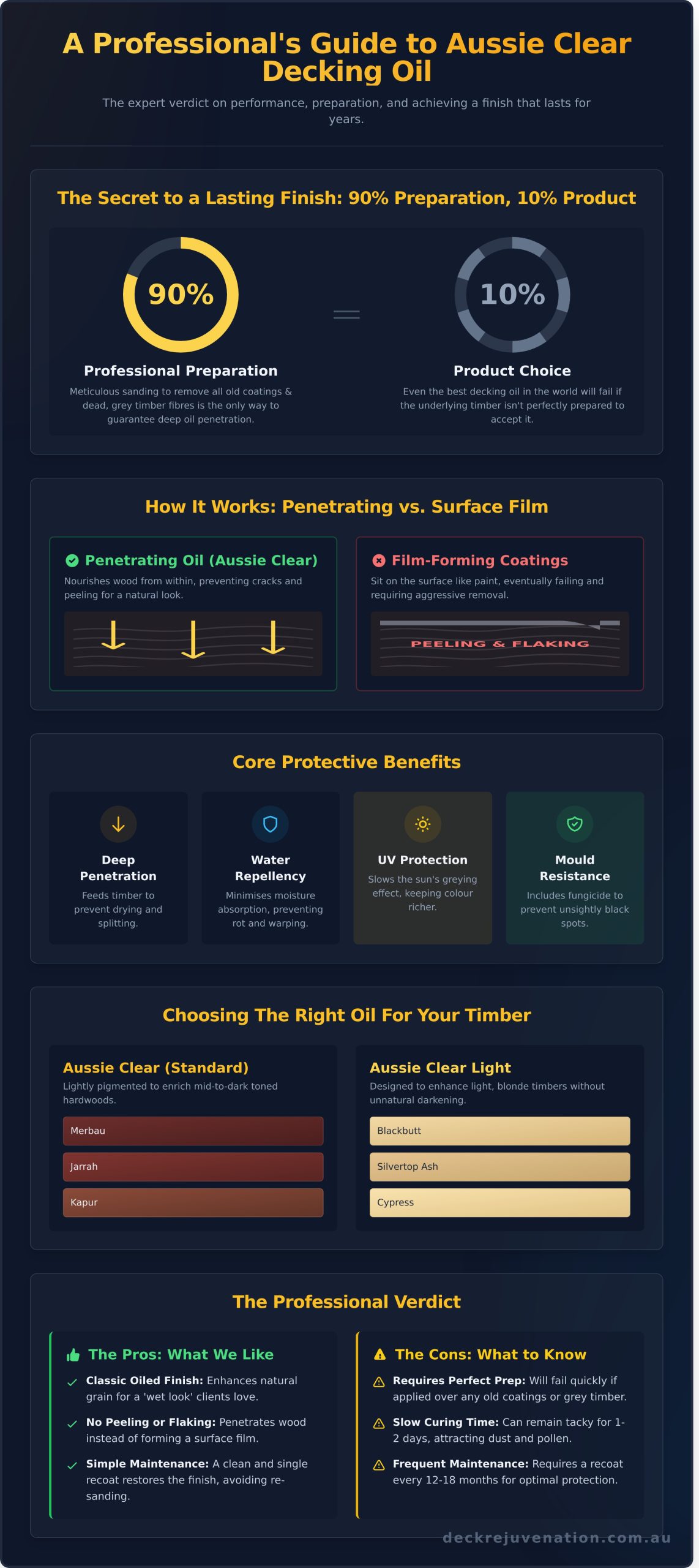
- Deep Penetration: It feeds the timber to stabilise it from the inside out, preventing the drying and splitting that leads to cupping and cracks.
- Water Repellency: The oil creates a hydrophobic barrier that minimises moisture absorption, a primary cause of rot, cupping, and board warping.
- UV Protection: It is formulated with robust UV inhibitors to significantly slow the greying effect of the sun, keeping your deck’s colour richer for longer.
- Mould and Fungus Resistance: Includes a broad-spectrum fungicide to prevent the growth of mould and algae, which cause those unsightly black spots.
Aussie Clear vs. Aussie Clear Light
Choosing the right product for your timber type is crucial for achieving the best finish. Preschem makes this straightforward. The standard Aussie Clear is lightly pigmented for mid-to-dark toned hardwoods like Merbau, Jarrah, and Kapur, enriching their deep, natural colours. For lighter, blonde timbers such as Blackbutt, Silvertop Ash, and Cypress, you must use Aussie Clear Light to avoid unnaturally darkening the timber. Both are designed to enhance, not hide, the timber’s inherent beauty.
The Professional Verdict: How Aussie Clear Performs in the Real World
After 17 years restoring Melbourne decks, I can tell you one thing with absolute certainty: the final result is 90% preparation and only 10% the product you choose. This is the single most important factor in how any decking oil performs. When applied to a meticulously sanded surface, free of all old coatings and dead timber fibres, Aussie Clear Decking Oil performs exceptionally well. However, if you slap it on a ‘pressure-washed only’ deck or over failing finishes, the results will be poor and short-lived.
It’s crucial to understand that no oil can magically fix underlying issues like cupped boards or penetrate through grey, UV-damaged timber. Removing this dead layer is the first step in all proper wood preservation best practices, as it allows the oil to soak in and protect the healthy wood beneath.
The Pros: What We Like About Aussie Clear
- It delivers a genuine, classic oiled finish that enhances the natural grain, a look our clients consistently love.
- As a penetrating oil, it soaks into the timber rather than forming a surface film. This means it won’t peel, crack, or flake like many acrylic stains.
- Maintenance is straightforward. A proper maintenance clean and a single recoat is usually all that’s needed to bring it back to life, avoiding the need for future sanding.
- It’s an Australian-made product, formulated for the harsh UV conditions and popular local timbers like Merbau and Spotted Gum we work with every day.
The Cons: What Homeowners Must Understand
- It is not a ‘magic bullet’. It requires pristine, professionally prepared timber to perform. It will highlight, not hide, poor preparation.
- It will fail quickly if applied over any remnant of old coatings or grey, weathered timber. The oil simply cannot penetrate and bond with the wood.
- The slow-curing nature of the oil means the finish can remain slightly tacky for a day or two, attracting dust, pollen, and pet hair during this time.
- It requires more frequent maintenance, typically a recoat every 12-18 months, compared to film-forming products that might last longer but present major issues when they eventually fail.
The Critical Step Before Oiling: Why Meticulous Sanding is Everything
You can buy the best product on the market, but if you apply it to a poorly prepared surface, you’re throwing your money away. This is the hard truth many homeowners learn too late. A quick pressure wash or deck clean might make the timber look better for a day, but it does nothing to prepare it for proper oil penetration. It simply pushes water into dead, grey fibres, creating the worst possible foundation for a new coat.
To get a flawless, long-lasting finish with a premium product like Aussie Clear Decking Oil, the surface must be professionally prepared. There are no shortcuts.
What Happens When You Oil a Poorly Prepared Deck?
Applying oil over a poorly sanded or merely “cleaned” deck is a recipe for disaster. The oil can’t penetrate the dense layer of dead, grey timber. Instead, it sits on the surface, leading to a host of problems:
- A muddy, blotchy finish: The oil mixes with the grey fibres, creating an uneven and unattractive appearance.
- Premature failure: Without deep penetration, the oil will peel, fade, or wear away within 6-12 months, leaving your deck exposed.
- Imperfections are highlighted: The fresh oil will draw attention to every cupped board, splinter, and rough patch instead of concealing them.
- Wasted time and money: You’ve spent good money on a quality oil and your valuable time on a job that was doomed from the start.
The Deck Rejuvenation Difference: Our Sanding Process
This is where our process sets a new standard. We don’t just clean; we restore the timber to its raw, perfect state. Our signature ‘5 waves of sanding’ is a meticulous, multi-stage process designed for maximum oil absorption and a flawless look. We start with heavy-grit papers to completely remove the damaged top layer, rectifying cupping and levelling the boards. We then progress through finer grits, smoothing the surface until it’s like a piece of indoor furniture. Our detailed edge and corner work ensures no part of your deck is overlooked. This opens the timber’s pores, allowing the oil to soak in deep for genuine, long-term protection.
Is Your Deck Ready for Oiling?
Before you even think about opening a can of oil, take a hard look at your deck. If you see any of the following, you need professional sanding first:
- The timber is grey, faded, or has a “furry” texture.
- The boards are cupped (curved upwards at the edges), creating an uneven surface.
- There are splinters, rough patches, or old, flaky coatings visible.
- Water splashed on the deck beads on the surface instead of soaking in.
Unsure? Don’t guess and risk a poor result. Get an honest, upfront assessment from our experts. We’ll tell you exactly what your deck needs.
How to Apply Aussie Clear The Professional Way
Let’s be direct: even the best oil in Australia will fail on a poorly prepared deck. This guide assumes you have already completed the hard work-a meticulous, full sand-back to fresh, raw timber. Before a single drop of oil touches your boards, a final wash and brighten is non-negotiable. This crucial step opens the timber grain, allowing the oil to achieve maximum penetration and bond with the wood fibres.
When working with a premium penetrating oil like Aussie Clear Decking Oil, the guiding principle is always less is more. You are feeding the timber, not painting a film on top of it. The goal is to saturate the boards and then remove every last bit of excess from the surface.
Tools and Techniques for a Flawless Finish
We exclusively use a quality lambswool applicator pad on a pole. Why not a roller? Because a roller is designed to leave a film on the surface, which is the opposite of what you want. A lambswool pad allows you to work the oil into the grain. After applying oil to 2-3 boards at a time (working their full length to avoid stop-marks), we immediately ‘back-brush’ with a decking brush. This ensures even coverage and works the oil deep into the timber.
Here is the single most critical step that separates a professional finish from a DIY disaster: after 30-60 minutes, you must return with clean, dry rags and wipe off all excess oil from the surface. If you leave pools of oil to dry on the deck, you are guaranteeing a sticky, tacky finish that will attract dirt and fail prematurely.
Common DIY Mistakes to Avoid
We’ve been called in to fix hundreds of decks where the application, not the oil, was the problem. Avoid these common shortcuts at all costs:
- Applying in direct sun: Oiling a deck on a 35-degree day causes the oil to flash-dry on the surface before it has a chance to penetrate the timber, resulting in a weak, uneven finish.
- Applying a thick second coat: A second coat should only be applied if the timber is still thirsty after the first. It should be a very light application, with all excess wiped off again. Never build a thick film.
- Failing to remove excess: We mention it twice because it’s that important. A tacky deck that you can’t walk on is the number one sign that excess oil was left to dry on the surface.
- Skipping the edges: The edges and ends of the boards are the most vulnerable points for moisture to get in, which leads to cupping and rot. Take the time to cut these in carefully with a brush.
Getting the application right is just as important as the preparation. If this meticulous process sounds like more than you want to handle, our professional team can guarantee a perfect finish every time.
Maintaining Your Aussie Clear Deck for Long-Term Protection
You’ve done the hard work of preparing and oiling your deck. The good news is that maintaining it is straightforward. Unlike film-forming coatings that crack and peel, requiring a full sand-back, an oil-based finish like Aussie Clear is designed for simple upkeep. However, you can’t just set and forget it, especially in Melbourne’s demanding climate with its harsh UV and variable rainfall.
A realistic expectation is to plan for a maintenance coat every 12 to 18 months. The key is to act before the timber’s protection is completely gone. Watch for these tell-tale signs:
- Water absorption: When water stops beading on the surface and starts to soak in, the oil’s repellency is fading.
- Colour fade: The deck may look dull or patchy, particularly in high-traffic zones or areas fully exposed to the sun.
The costliest mistake homeowners make is letting the deck weather completely grey. This means the timber fibres are damaged, and what should have been a simple clean and recoat becomes a much more involved and expensive restoration project. Proactive maintenance is always the better, more affordable option.
The Annual Maintenance Process
When it’s time for a recoat, the process is simple and doesn’t involve heavy sanding. It’s a meticulous clean followed by a single, light application of Aussie Clear Decking Oil. First, give the deck a thorough clean with a dedicated deck cleaning product and a stiff bristle broom to remove any surface grime. Never use a high-pressure jet wash, as it will tear and fuzz the timber fibres, causing irreversible damage. Allow the deck to dry completely for at least 24-48 hours before applying one light maintenance coat, ensuring you wipe off any excess oil that hasn’t penetrated the timber.
Professional vs. DIY Maintenance
While a maintenance coat is a manageable DIY project, a professional service guarantees the job is done right, protecting your investment without you lifting a finger. Our meticulous process ensures the deck is properly cleaned and the oil is applied correctly for maximum longevity. More importantly, we bring an expert eye. We can spot and rectify potential issues like loose boards, developing rot, or drainage problems before they become serious headaches. If you want peace of mind and a perfectly protected deck, year after year, we can help. Book your annual deck maintenance service with us.
The Final Verdict: Product vs. Preparation
So, what’s our final take? After extensive use in the field, our professional assessment is that Aussie Clear Decking Oil is a genuinely good product. However, this review has shown that even the best oil in the world will fail if the preparation is poor. The single most critical factor for a long-lasting, beautiful finish is not the can of oil, but the meticulous sanding and preparation of the timber beneath it. This is where most DIY projects and budget contractors fall short.
While Aussie Clear is a quality oil, the secret to a finish that lasts for years, not months, is professional preparation. As a family business with over 17+ years of deck restoration experience, we’ve built our reputation on honest advice and zero shortcuts. Our meticulous 5-Wave Sanding Process ensures your deck is perfectly prepared for maximum oil penetration and longevity. Get a quote for our 9-step deck rejuvenation service and see the difference a professional foundation makes.
Your deck is a valuable asset. Let’s protect it the right way.
Frequently Asked Questions About Aussie Clear Decking Oil
How long does Aussie Clear decking oil last in Melbourne?
In Melbourne’s harsh climate, a fully exposed deck will typically require a maintenance coat every 6 to 9 months. For a deck with good overhead protection from sun and rain, you can expect the coating to last 12 to 18 months. Longevity depends entirely on preparation and exposure. A meticulous sanding and cleaning process is non-negotiable for achieving maximum durability; without it, even the best oil will fail prematurely.
Can you apply Aussie Clear over an old coating like Cabot’s Aquadeck?
Absolutely not. This is a critical mistake we are often called in to rectify. Aquadeck is a water-based acrylic that forms a film on the surface. Aussie Clear is a penetrating oil that must soak into the timber fibres. Applying it over a film will result in a sticky, peeling disaster because the oil cannot penetrate. The old coating must be completely sanded back to bare, raw timber before applying any oil. There are no shortcuts here.
Is Aussie Clear a good choice for a Merbau or Spotted Gum deck?
Yes, it’s an excellent choice for dense Australian hardwoods like Merbau and Spotted Gum. As a penetrating oil, it’s formulated to soak deep into the timber grain, nourishing the wood from within. This process highlights the natural character, depth, and colour of these premium timbers beautifully. It provides a genuine, natural-looking finish that avoids the artificial, plastic-like appearance of many film-forming products on the market.
What is the ideal drying time for Aussie Clear between coats?
While the instructions on the tin provide a guide, real-world conditions in Melbourne dictate the true drying time. We always recommend a minimum of 24 hours between coats. In cooler or more humid weather, you must extend this to 48 hours. Applying the second coat too soon is the number one cause of a tacky finish. If the surface feels even slightly oily or sticky to the touch, it is not ready. Be patient and give it more time.
Does Aussie Clear change the colour of the timber?
Yes, it enhances and deepens the timber’s natural colour, creating what is often called a “wet look.” It is not a paint or a heavy, opaque stain that will hide the grain. Instead, it is designed to enrich what is already there, making the natural features and colours more vibrant. For example, a weathered, pale piece of Merbau will return to its deep, rich red-brown hue once the oil is applied, bringing the timber’s character back to life.
Why has my Aussie Clear deck gone sticky or tacky?
A sticky deck is almost always caused by one of two application errors. The most common is over-application-the timber can only absorb a certain amount of oil, and any excess left on the surface will fail to cure properly. The second cause is recoating before the previous coat has fully dried. This traps solvents and prevents the oil from hardening, leaving a tacky film that attracts dirt and grime. Meticulous application is key to avoiding this outcome.
Where can I buy Aussie Clear decking oil in Melbourne?
You will typically find Aussie Clear decking oil at specialist timber suppliers and independent paint stores, not at the large-format hardware superstores. We recommend checking with local, trade-focused businesses like Demak Timber, Tait Timber & Hardware, or other dedicated timber yards around Melbourne. It’s always a good idea to call ahead to ensure they have the product in stock before you make the trip.
Leave a Reply