
Choosing the right finish for your timber deck can be a confusing, high-stakes decision. You’ve invested in a beautiful outdoor space, and the fear of wasting a weekend-and hundreds of dollars-on the wrong product is real. As professional deck restorers, we see the costly results of bad advice all the time, and a top-tier product like Feast Watson decking oil is no exception. It’s a premium Australian brand, but the truth is, the oil in the tin is only half the story.
This is our honest, no-shortcuts review. We’re cutting through the online noise to give you the facts. You will learn exactly which Feast Watson oil is right for your timber, how to execute the meticulous preparation that guarantees a lasting finish, and the correct application techniques the pros use. Forget the guesswork. This is your guide to protecting your investment and getting the job done right, the first time.
Key Takeaways
- Meticulous preparation is the non-negotiable secret to a professional, long-lasting deck finish; the best oil will fail on a poorly prepped surface.
- Learn how to select the right Feast Watson decking oil for your specific timber type, whether it’s Merbau, Spotted Gum, or Treated Pine.
- Discover the professional application techniques that aren’t on the back of the can to achieve a flawless, even coat without drips or blotches.
- Avoid the three most common-and costly-DIY mistakes that we’re called in to fix, so you can get the job done right the first time.
What is Feast Watson Decking Oil? A Pro’s Breakdown
Feast Watson is a household name in Australia for a reason. Their products are reliable and widely available. As professional deck restorers, we’ve used countless tins of their oils over the years. But we need to be clear: we don’t sell their products. We use them. This gives us an honest, on-the-ground perspective on what works and what doesn’t.
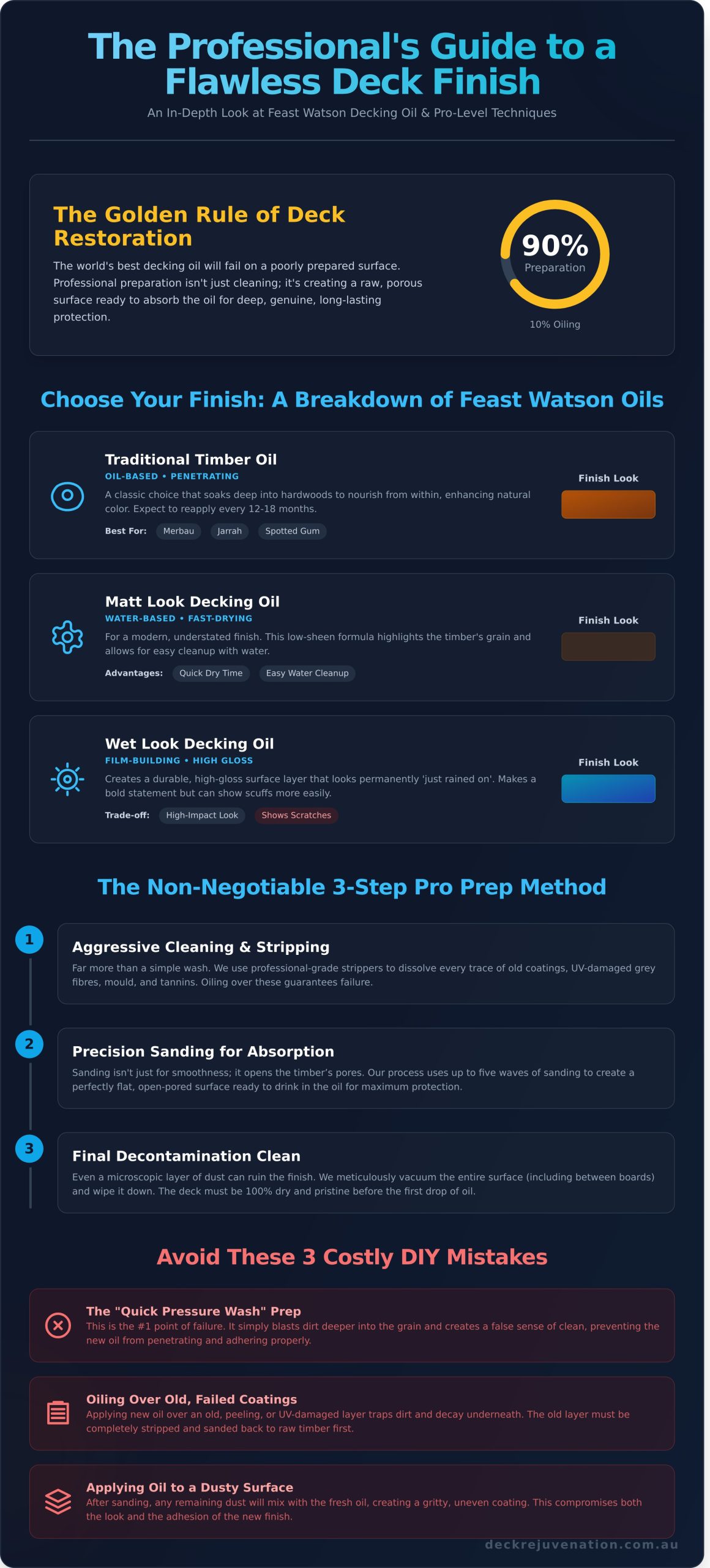
The best feast watson decking oil in the world will fail if the timber isn’t meticulously prepared. A quality result is less about the brand and more about the process; a core principle in understanding wood finishing is that preparation dictates performance. Here’s our professional breakdown of their main decking oil types.
Feast Watson Traditional Timber Oil
This is the classic choice for a reason. It’s a penetrating, oil-based formula designed to soak deep into dense Australian hardwoods like Merbau, Jarrah, and Spotted Gum. Instead of sitting on top, it nourishes the timber from within, enhancing its natural colour and providing a rich, timeless look. In Melbourne’s harsh climate, expect to reapply this oil every 12-18 months to maintain protection and appearance.
Feast Watson Matt Look Decking Oil
For a more modern, understated finish, the Matt Look oil is an excellent choice. This water-based formula offers a low-sheen, natural appearance that highlights the timber’s grain without the high-gloss ‘wet look.’ Its main advantages are practical: it dries significantly faster and allows for easy cleanup with water. It’s the perfect option when you want the timber itself to be the hero, not the coating.
Feast Watson Wet Look Decking Oil
As the name suggests, this product delivers a high-gloss finish that looks permanently ‘just rained on.’ Unlike penetrating oils, this is a film-building coating that creates a durable, protective layer on the timber’s surface. This look is desirable for creating a bold statement, but be aware that the high gloss can show scuffs and scratches more readily than a matt or traditional finish. It’s a trade-off between a high-impact look and day-to-day practicality.
The Secret to Success: Why Preparation is 90% of the Job
Let’s be direct: you can buy the best decking oil on the market, but it will fail miserably on a poorly prepared deck. This is the single biggest point of failure for DIY projects and the corner most cheap contractors cut to save time and money. They’ll give your deck a quick pressure wash and call it ‘prepped’, but all they’ve done is blast dirt into the timber grain and create a false sense of clean.
Proper preparation isn’t about surface-level cleaning. It’s about creating a raw, porous, and perfectly clean surface that allows a premium product like Feast Watson decking oil to penetrate deep into the timber. This deep penetration is what provides genuine, long-lasting protection. A surface coat just sits on top, ready to peel and fade in a few months.
Step 1: Aggressive Cleaning and Stripping
This is far more than a simple wash. Our first job is to remove every trace of old, failed coatings, UV-damaged grey fibres, mould, and timber tannins. We use professional-grade, biodegradable strippers to safely dissolve these old layers. This is a critical step, as many older treatments contain complex chemicals, as detailed in the EPA guidelines on wood preservatives. Simply oiling over them traps dirt and decay, guaranteeing a poor result.
Step 2: The Critical Role of Precision Sanding
Sanding isn’t just for smoothness; it’s for absorption. Our meticulous process involves up to five waves of sanding with progressively finer grits. This does more than just remove the last remnants of old coatings-it opens up the timber’s pores and, crucially, allows us to rectify common issues like cupping and uneven boards. The goal is a perfectly flat, open-pored surface that is ready to drink in the Feast Watson decking oil for maximum protection.
Step 3: Final Clean Before Oiling
Even a microscopic layer of dust can ruin the final finish, mixing with the oil to create a gritty, uneven coating that compromises adhesion. After sanding, we don’t just sweep up. We meticulously vacuum the entire surface, including between the boards, and then wipe it down with a damp cloth to remove any final residue. The deck must then be left to become completely and utterly dry. Only when the timber is pristine and moisture-free is it ready for the first drop of oil.
How to Apply Feast Watson Decking Oil for a Flawless Finish
You’ve done the hard yards with meticulous preparation. Now comes the application-the step that separates a professional, long-lasting finish from a blotchy, sticky mess. The instructions on the can are a starting point, but the genuine craft lies in the technique. Getting this right ensures the oil penetrates deeply, protects properly, and looks impeccable.
Choosing the Right Applicator
The tools you use are just as important as the oil itself. For the main deck area, nothing beats a lambswool applicator on a quality extension pole. It allows for a fast, even application without breaking your back. However, it can’t get into corners or tight against posts. That’s where a good quality decking brush (75-100mm) is essential. We use a combination: the brush for cutting in and the lambswool for the long runs. One tool you must avoid is a roller. Rollers apply the oil far too thickly, causing pooling and preventing proper absorption, which leads to a tacky finish that fails prematurely.
Applying the First and Second Coats
Your application process should be methodical. First, use your brush to ‘cut in’ around the perimeter of the deck, posts, and any built-in features. Once the edges are done, load your lambswool applicator and apply thin, even coats, working along the full length of 2-3 boards at a time. This prevents ugly stop-start marks. The most crucial professional technique is back-brushing. After applying oil to a small section, lightly run the applicator back over it to smooth the finish and remove any excess. This simple step is the key to avoiding pools and ensuring the oil can penetrate the timber fibres, which is fundamental to the science of wood preservation. Always adhere strictly to the recoat times on the can.
Weather and Timing are Everything
Applying decking oil in the wrong conditions is a recipe for failure. Never apply it in direct, hot sunlight or onto a deck surface that’s hot to the touch. Heat causes the solvents in the Feast Watson decking oil to evaporate too quickly, making the oil flash-dry on the surface instead of soaking into the timber. Here in Melbourne, we know the weather is unpredictable; you need a clear 24-48 hour window with no rain. The ideal temperature for application is between 10°C and 30°C. Picking the right day isn’t just a suggestion-it’s a non-negotiable part of achieving a durable, flawless result.
Top 3 DIY Mistakes to Avoid When Using Feast Watson Oil
In our 17+ years of rectifying failed decking projects, we see the same costly errors time and time again. A weekend DIY job can quickly turn into an expensive professional fix when simple rules are ignored. This isn’t about selling our services; it’s about providing honest advice to help you avoid the sticky, peeling mess we’re so often called to repair. Understanding these common pitfalls highlights the value of a meticulous, professional process.
Mistake #1: Applying Over an Old, Failed Coating
You cannot put new oil over an old, sealed surface. It’s a non-negotiable rule. A premium Feast Watson decking oil is a penetrating product, meaning it’s designed to soak deep into the timber grain to protect it from within. If an old, flaky coating is in the way, the new oil has nowhere to go. It will simply sit on top, creating a tacky film that never properly cures. The result is a sticky mess that peels within months and is incredibly difficult and expensive to strip back and fix. All previous coatings must be completely sanded off to expose fresh, bare timber. Anything less is a guarantee of failure.
Mistake #2: Applying the Oil Too Thickly
The myth that ‘more is better’ is a fast track to a blotchy, dirty deck. The goal is to feed the timber until it is saturated, not to create a thick paint-like film on the surface. When you apply the oil too heavily, the timber absorbs what it can, and the excess pools on top. This unabsorbed oil won’t dry properly and becomes a magnet for dust, pollen, and footprints. This creates an ugly, uneven finish that is difficult to clean and maintain. The correct technique is to apply thin, even coats and, most importantly, wipe off any excess oil that hasn’t penetrated after 30-45 minutes.
Mistake #3: Inadequate Sanding (or Skipping It Entirely)
This is the single biggest cause of premature failure we see. A quick, light scuff-sand with a handheld sander is simply not enough to prepare timber for oiling. To achieve maximum longevity, the timber grain must be properly opened up to allow for deep oil penetration. A superficial sand leaves the pores of the wood closed, meaning the oil can only sit in a thin layer on the surface. This leads to the finish weathering away far too quickly, often leaving your deck exposed and grey within a single season. Proper preparation is 90% of the job. Don’t risk it. See how our meticulous sanding process makes all the difference.
The Verdict: Is Feast Watson the Right Oil for Your Deck?
Feast Watson is a respected Australian brand offering a quality range of decking oils, from their traditional oil-based products to modern water-based solutions. The right choice for your project will always depend on your timber type, its condition, and the final look you want to achieve.
However, the single most important factor in a long-lasting deck finish is not the brand of oil you choose. It’s the quality of the preparation. A meticulously sanded and prepared deck coated with a mid-range oil will always outperform a premium feast watson decking oil applied to a poorly prepared, dirty, or weathered surface. The key to longevity is maximum penetration, and that only happens when the timber pores are perfectly clean and open.
When to DIY vs. When to Call a Professional
We believe in honest advice. A DIY approach can be successful if you have a small, new deck in excellent condition. For anything else, you need to weigh the true costs and risks. Consider hiring a professional if your deck is:
- Large, heavily weathered, or greyed-out.
- Covered in a peeling or failing previous coating.
- Showing signs of damage, like splintering or cupped boards.
Remember to factor in the real cost of DIY, including hiring a professional-grade floor sander (often over $100 per day), purchasing multiple sanding pads, oils, and quality applicators. A failed attempt can cost double to rectify.
Achieving a Finish That Truly Lasts
A professional deck restoration is an investment in your home’s value and your own time. Our meticulous 9-step process, which includes levelling cupped boards and precision sanding, is designed to ensure the deepest possible oil penetration and a flawless finish. We guarantee a result free of the streaks, blotches, and premature failures that are all too common in DIY projects.
Instead of spending your weekends with hired equipment and the stress of getting it right, you can rely on an expert finish that protects your timber for years. Save yourself the time and risk of a costly mistake. If you want an honest assessment of your deck, contact our team for expert advice.
The Professional’s Final Take on Feast Watson Decking Oil
So, what’s our honest verdict? Feast Watson is a premium, Australian-made oil capable of delivering an excellent result. But as we’ve covered, the product in the tin is only one part of the puzzle. The true secret to a deck that lasts isn’t the oil itself, but the meticulous preparation and flawless application-the 90% of the job where most DIY attempts and cut-price contractors fail.
Applying feast watson decking oil correctly demands more than just a weekend and a roller. It requires precision that only comes with experience. A single shortcut on sanding or a missed step in cleaning can lead to a blotchy finish that peels within a season, wasting your time and money. That’s a costly mistake we refuse to make.
As a Melbourne family business with over 17+ years of hands-on experience, we built our reputation on one simple principle: Honest Advice. No Shortcuts. Our meticulous 9-step restoration process guarantees perfect preparation and deep oil penetration for a superior result that protects your timber for years. Ensure a flawless, long-lasting finish. Get a quote for professional deck oiling today.
Frequently Asked Questions About Feast Watson Decking Oil
How long does Feast Watson decking oil last?
In the harsh Australian sun, you should expect to recoat your deck every 12 months for optimal protection. While some products make unrealistic claims, the truth is that UV exposure, weather, and foot traffic dictate the lifespan. A fully exposed, high-traffic deck will always require more frequent maintenance than a sheltered one. Regular recoating is the only genuine method to ensure long-term timber health and prevent costly restoration work down the line.
Can I apply Feast Watson oil over an old coating or stain?
Absolutely not. This is a critical mistake that guarantees a poor result. Decking oil must penetrate the timber to nourish and protect it. Applying it over an old, peeling stain or varnish is a waste of time and money, as the oil cannot soak in. It will simply sit on the surface and fail quickly. Proper preparation always involves stripping the deck back to bare, clean timber. There are no shortcuts to a professional, long-lasting finish.
What is the drying time for Feast Watson decking oil?
Drying time is heavily dependent on weather conditions. In warm, dry weather, the oil may be touch-dry in 4-6 hours and ready for a recoat after 12 hours. However, we advise against rushing the process. Allow a full 24 hours before any light foot traffic and at least 7 days for the oil to fully cure and harden. Placing heavy furniture on the deck before it has fully cured can easily damage the new finish.
How many coats of Feast Watson decking oil do I need?
We always apply a minimum of two generous coats. The first coat is the most important, as it penetrates deep into the timber to provide nourishment. The second coat builds up the protection and ensures an even, consistent finish. For particularly dry or porous timbers, a third coat may be required for full saturation. Applying a single coat is a common shortcut that leaves your deck under-protected and guarantees premature failure of the coating.
Is Feast Watson decking oil water-based or oil-based?
Feast Watson produces both types to suit different needs. The traditional Feast Watson Decking Oil is an oil-based formula, renowned for its deep penetration that nourishes timber from within. They also offer modern water-based formulas, which provide faster drying times and easier clean-up with water. The correct choice depends on your timber and desired outcome, but for genuine, deep protection, a traditional penetrating oil is often the superior method.
How do I clean my deck once it has been oiled with Feast Watson?
For routine cleaning, a stiff-bristled broom and a good hose-down are sufficient. For a deeper clean, avoid using high-pressure washers or harsh household detergents, as these will strip the protective oil from the timber. Instead, use a specialised, pH-neutral deck cleaning product designed for oiled decks. This will effectively clean the surface grime without compromising the finish, helping your investment last much longer between recoats.
Leave a Reply