Choosing the right oil for your Melbourne deck shouldn’t feel like a gamble. Yet, you’re faced with a wall of options, conflicting online advice, and the nagging worry that you’ll spend an entire weekend on the job only for it to look patchy and worn in six months. So when it comes to a professional-grade product like H2Oil Timber Oil, how do you know if it’s the right choice for your timber? Is it genuinely better for our harsh climate than a well-known brand like Cabot’s?
After 17 years of restoring decks across Melbourne, we cut through the marketing noise. We’ve used it all, and we believe in honest advice, not sales pitches. In this detailed assessment, we’ll show you how H2Oil performs in the real world, how it stacks up against the competition, and reveal the professional secret that truly makes a finish last. Hint: it’s not just what’s in the can, but the meticulous preparation that most people skip.
What is H2Oil Timber Oil? An Expert’s First Look
When clients ask what we use on their decks, one name comes up more than any other: H2Oil by Haymes Paint. This isn’t just another deck stain; it’s a premium, water-based penetrating oil manufactured right here in Australia. It was specifically formulated to stand up to the brutal sun and unpredictable weather we face, from scorching summers to wet Melbourne winters.
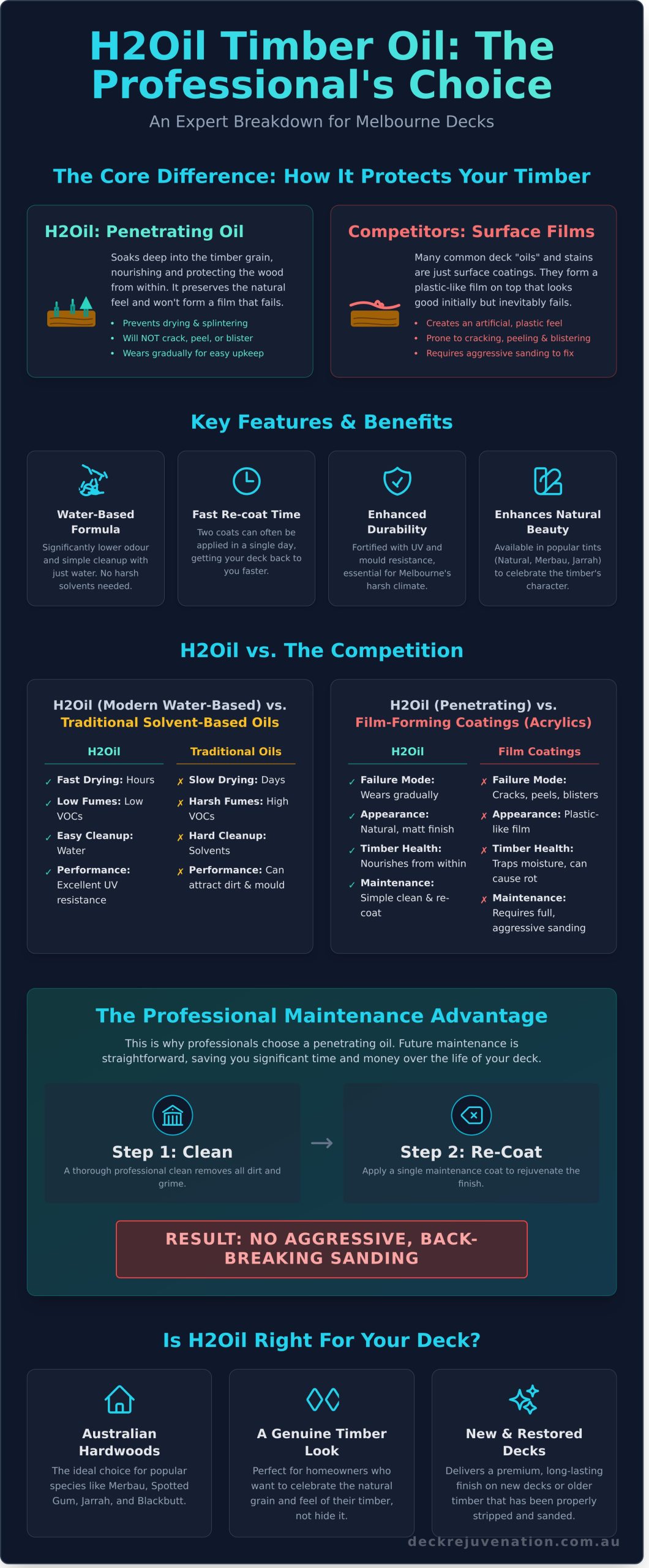
The fundamental difference lies in how it protects your timber. Many common deck “oils” and stains are little more than surface coatings. They form a film on top of the wood that looks good for a few months before it inevitably cracks, peels, and fails. H2Oil Timber Oil does the opposite. It penetrates deep into the timber grain, nourishing and protecting the wood from within. This approach is central to the process of wood finishing that ensures long-term protection, not a temporary facelift. It preserves the natural look and feel of the timber, preventing it from drying out and splintering.
It’s no surprise this product is a favourite among seasoned professionals. Its straightforward application and consistent, high-quality finish mean we can deliver results we’re proud to stand behind.
Key Features and Technical Specifications
Here are the technical details that matter for your project:
- Water-Based Formula: This means significantly lower odour during application and simple, fast cleanup with just water-no harsh solvents required.
- Fast Re-coat Time: We can often apply the necessary two coats in a single day, getting your deck back to you faster without compromising on protection.
- Enhanced Durability: It’s fortified with excellent UV and mould resistance, a non-negotiable feature for timber survival in a climate like Melbourne’s.
- Popular Colour Tints: Available in a range of tints to enhance the natural beauty of your timber, including Natural, Merbau, and Jarrah.
Who Should Use H2Oil Timber Oil?
We recommend this oil for specific scenarios to achieve the best outcome:
- It is the ideal choice for popular Australian hardwoods like Merbau, Spotted Gum, Jarrah, and Blackbutt, bringing out their rich, natural character.
- Perfect for homeowners who want to celebrate the genuine look of their timber, rather than covering it with an artificial, paint-like finish.
- It delivers a premium finish on both brand new decks and older decks that have been professionally stripped and sanded back to bare timber.
H2Oil Performance Review: Why We Use It on Melbourne Decks
Talk is cheap. Any product can make bold claims on the label, but the real test is how it performs year after year on a real deck. After restoring and protecting hundreds of timber decks across Melbourne, we’ve seen what works and what fails. We choose H2Oil Timber Oil because our reputation depends on delivering a finish that lasts, and this product consistently stands up to Melbourne’s punishing ‘four seasons in one day’ climate.
This isn’t a theoretical review; it’s based on years of hands-on experience seeing how this oil protects our clients’ investments from searing summer sun to damp winter mornings.
Durability and Protection Against the Elements
The number one job of a deck coating is protection. When correctly applied after meticulous preparation, H2Oil provides exceptional water repellency, causing rain to bead and run off rather than soak in and cause rot. It’s also formulated with premium UV inhibitors that genuinely slow the destructive greying process. This helps prevent the timber from drying out, which leads to common problems like splitting and checking.
Crucially, H2Oil is a penetrating oil. It soaks into the timber fibres to nourish and protect from within. Unlike film-forming acrylics or varnishes which create a surface layer prone to failure-a common topic in any good comparison of outdoor wood finishes-H2Oil will not crack, peel, or blister. It simply wears gradually over time, making future maintenance far simpler.
Aesthetic Finish on Different Timber Species
A great finish should protect the timber without hiding its character. H2Oil excels at enhancing the natural beauty of the wood. On a Spotted Gum deck, the ‘Natural’ tint is our go-to choice, as it beautifully highlights the timber’s unique grain and colour variations. For the ever-popular Merbau, it delivers a rich, deep colour that looks premium and authentic.
The result is a modern, matt finish that feels natural underfoot. You get the full tactile experience of the timber, not a slippery, plastic-like film that looks and feels artificial.
Long-Term Maintenance: The Re-coating Advantage
This is where H2Oil truly separates itself from the competition and why it’s a favourite among professionals. Long-term maintenance is straightforward and doesn’t require a complete do-over. When the deck starts to look tired, the process is simple:
- A thorough professional clean to remove dirt and grime.
- Application of a single maintenance coat of oil.
There is absolutely no need for aggressive, back-breaking sanding to remove a failed coating. This simple clean and re-coat process saves homeowners significant time and money over the life of their deck. This ease of maintenance is a key reason we stand behind it. See examples of our H2Oil finishes in our before and after gallery.
H2Oil vs. The Competition: A Professional Comparison
After 17 years of restoring decks, you learn to see past the marketing hype on the tin. What matters is how a product performs in the harsh Australian sun, month after month. Our choice of coating is based on one thing: what delivers the best long-term result for our clients. It’s not about what’s cheapest or easiest. It’s about genuine timber protection. Here’s a no-nonsense breakdown of why we consistently choose H2Oil over other popular options.
H2Oil vs. Traditional Oil-Based Decking Oils
The old-school thinking was that only solvent-based oils could truly penetrate timber. Technology has moved on. Modern water-based formulas like H2Oil have been engineered to offer deep penetration without the significant drawbacks of traditional oils. In our field experience, the advantages are clear:
- Health and Speed: H2Oil has very low VOCs and dries in hours, not days. This means your deck is back in action faster, and your family isn’t breathing in harsh fumes.
- Cleaner Finish: Traditional oils often remain sticky, attracting dirt, pollen, and even promoting mould growth in damp, shaded areas. Water-based oils dry to a hard, non-tacky finish.
- Colour Stability: Many oil-based products are prone to yellowing and darkening significantly over time, masking the timber’s natural beauty. H2Oil maintains its colour integrity for longer.
H2Oil vs. Cabot’s Aquadeck
This is the comparison that matters for most homeowners. Both are leading water-based products, but they deliver very different outcomes. Aquadeck is a solid DIY product, but for a professional finish and superior longevity, we find it falls short. The key difference is the finish. Aquadeck tends to sit on the surface, creating a film that can look slightly ‘painted’. Over time, this film can peel or flake, especially in high-traffic areas, making future preparation more intensive.
In contrast, the H2Oil Timber Oil penetrates deeper, enhancing the natural grain and providing a more authentic, ‘in-the-wood’ look. It wears more evenly, typically by fading rather than peeling. This makes the all-important recoat process simpler and more effective, saving you money and hassle down the line. While both require meticulous prep, we find H2Oil is more forgiving of application nuances, resulting in a more consistent, professional-grade finish every time.
The Secret to a Perfect H2Oil Finish: It’s All in the Prep
You can buy the most premium product on the market, but even the best H2Oil Timber Oil will fail if it’s applied to a poorly prepared deck. This is the single biggest factor that separates a professional result from a DIY job that looks tired in six months. The secret isn’t in the can; it’s in the meticulous, non-negotiable work we do before a single drop of oil touches your timber.
This is where most decking companies take shortcuts to save time and money. We do the opposite. Our process is designed for one thing: maximum oil penetration and long-term protection for your investment.
Why Meticulous Sanding is Essential
Sanding is not just for looks; it’s a critical technical step. Our 5-wave sanding process removes the entire top layer of grey, dead timber fibres. This exposes fresh, porous wood ready to absorb the oil. More importantly, it opens the timber’s grain, allowing the oil to penetrate deep into the boards instead of sitting on the surface. Without proper sanding, any oil-no matter how expensive-will simply form a thin film that peels and wears away under the harsh Australian sun.
The Role of Cleaning and Brightening
After sanding, your deck looks clean, but invisible contaminants remain. We apply a professional-grade cleaning solution to draw out stubborn tannins, dirt, and oils that block absorption. This is followed by a brightener that neutralises the timber’s pH. This two-step process is crucial for achieving a vibrant, even colour and prevents the blotchy, inconsistent finish you often see on poorly prepared decks.
Correcting Deck Issues Before Oiling
A genuine rejuvenation goes deeper than the surface. Before we sand or clean, we perform essential structural corrections that others ignore. This is what we mean by no shortcuts.
- Countersinking Nails: We check and punch every nail or screw below the timber surface. This prevents them from shredding our sanding equipment and creating a dangerous snagging hazard on your finished deck.
- Rectifying ‘Cupped’ Boards: Warped, cupped boards are a common Australian problem. They trap water, promote rot, and create an uneven surface. We have a proven process to rectify and level these boards, restoring the safety and usability of your deck.
This comprehensive preparation is the foundation of a lasting finish. It ensures the H2Oil Timber Oil can perform exactly as it was designed to, giving you a result that is both beautiful and durable. If you’d like an honest assessment of what your deck needs, get in touch with our team.
Common Mistakes to Avoid When Applying H2Oil
Even a premium product like H2Oil Timber Oil can deliver a disappointing result if the preparation and application are flawed. We see it all the time: homeowners invest in a quality oil but end up with a finish that fails within a year. These common DIY mistakes highlight why a professional, meticulous process is the only way to guarantee a long-lasting, beautiful finish for your deck.
Mistake #1: Skimping on the Sanding
The most common shortcut is the ‘quick pressure wash and coat’. This is a recipe for failure. A pressure washer alone cannot remove the dead, grey timber fibres or stubborn old coatings. When you apply oil over this compromised surface, it can’t penetrate the wood. Instead, it sits on top, leading to:
- Peeling and flaking within months as the oil has nothing to bond to.
- A dark, muddy appearance because you’re trapping the grey, weathered timber underneath.
- Patchy, uneven results where remnants of old coatings block the new oil from soaking in.
Mistake #2: Incorrect Application Technique
How the oil is applied is just as critical as the prep work. Applying it incorrectly can ruin the look and feel of your deck. Key errors include applying the oil too thickly, which creates a sticky, dust-and-dirt-attracting surface that never truly cures. Another frequent mistake is working in direct, hot sun. This causes the oil to flash-dry on the surface, preventing it from penetrating deep into the timber grain where it needs to be. Finally, failing to maintain a ‘wet edge’ during application will leave you with ugly, visible lap marks and lines across the boards.
The Professional Difference: No Shortcuts
Our process is built on avoiding these exact mistakes. We don’t take shortcuts because we know they don’t work. We use professional-grade, dust-extracting sanders to take your deck back to fresh, bare timber, creating the perfect canvas for deep oil penetration. Our experienced team understands the precise amount of oil your specific timber needs-enough for total protection, but never so much that it becomes sticky.
The result is a flawless, even finish that not only looks superior but also provides genuine, long-lasting protection for your investment. Don’t risk a costly mistake. Get an honest quote for a professional finish.
H2Oil Timber Oil: The Professional Verdict for Melbourne Decks
As we’ve covered, our hands-on experience confirms that H2Oil is a premium, high-performance coating that stands up to Melbourne’s demanding climate. It offers excellent protection and enhances the timber’s natural grain beautifully. However, the key takeaway is this: the best oil in the world can’t compensate for poor preparation. A flawless, long-lasting finish is 90% about the meticulous sanding and cleaning that happens before the can is even opened.
A superior product like H2Oil Timber Oil deserves a superior application to unlock its true potential. As a family business with over 17 years of experience restoring Melbourne decks, we provide honest advice and a meticulous 9-step process with no shortcuts. We ensure the groundwork is perfect so the final finish is flawless and durable.
Ready to see the difference a professional touch makes? Get a quote for a professional deck restoration using premium oils. Let’s give your deck the expert attention it deserves.
H2Oil Timber Oil: Frequently Asked Questions
How long does H2Oil Timber Oil last on a deck in Melbourne?
Melbourne’s harsh UV and variable weather are tough on any coating. For a fully exposed deck, you can expect H2Oil Timber Oil to last around 9-12 months before a maintenance coat is needed. On a covered or partially shaded deck, you could get up to 18 months. The key is proper preparation-thorough sanding and cleaning. Without that solid foundation, no oil will perform as it should. We see too many decks fail early because of shortcuts taken during preparation.
Is H2Oil a penetrating oil or a film-forming coating?
H2Oil is a genuine penetrating oil. It soaks deep into the timber grain to nourish and protect it from within, which is the correct way to treat a deck. This is fundamentally different from cheap, film-forming coatings that simply sit on the surface. These surface films look good for a few months but inevitably crack, peel, and trap moisture, leading to rot. Genuine penetration is non-negotiable for long-term deck health and avoids these costly problems.
Can I apply H2Oil over an old, different brand of decking oil?
No, and we strongly advise against it. Applying a new oil over an old, failing one is the biggest shortcut in the industry and guarantees a poor result. The old coating will prevent the new oil from penetrating properly, leading to a patchy, sticky finish that fails quickly. The only correct method is to completely strip and sand the deck back to bare timber. This ensures the H2Oil can absorb evenly and provide the genuine protection your deck deserves.
How many coats of H2Oil are needed for the best protection?
For a newly prepared or sanded deck, two coats are essential for optimal protection. The first coat is the most critical, as it deeply penetrates and seals the timber. The second coat builds on this foundation, evening out the finish and providing an extra layer of defence against moisture and UV damage. On dense hardwoods like Merbau or Spotted Gum, a third light coat can sometimes be beneficial if the timber is particularly thirsty, but two is the standard for a professional result.
What is the recommended maintenance schedule for a deck coated with H2Oil?
A proper maintenance schedule prevents the need for costly, full-scale restorations later. We recommend inspecting your deck every 6 months. Look for signs of water no longer beading on the surface or a slight fading in colour. For most Melbourne decks, a simple clean and a single maintenance coat of H2Oil every 12 months is sufficient to keep it protected and looking its best. Don’t wait until the timber is grey and cracking; proactive maintenance is always smarter.
Is H2Oil slippery when wet?
When applied correctly, H2Oil is not slippery. Because it’s a penetrating oil, it soaks into the timber rather than forming a glossy film on the surface. Slipperiness is a common problem with cheap, film-forming coatings that create a plastic-like layer. H2Oil maintains the natural texture of the wood, providing good grip. However, any deck can become slippery if surface contaminants like dirt, algae, or mould are allowed to build up, so regular cleaning is key.
Leave a Reply