Let’s be direct. You’re looking at your timber deck and weighing your options. On one hand, you have the common, cheaper oils that promise a quick fix. On the other, you have a premium, Australian-made product like Organoil, and you’re asking the right question: is it worth the investment? Making the wrong choice doesn’t just waste a weekend; it can lead to a peeling, faded deck in under 12 months, forcing you to start the entire costly process over again.
The truth is, a lasting finish has less to do with marketing and more to do with two things: using a genuine penetrating oil that feeds the timber, and meticulous preparation. Most failures we see are not because of a bad product, but because critical steps were skipped. In this professional’s guide, we cut through the noise. We’ll show you exactly why we trust Organoil, how to choose the right product for your specific timber, and detail the preparation process that guarantees a beautiful, protected deck that endures. No shortcuts, just honest advice.
What is Organoil and Why Do Professionals Use It?
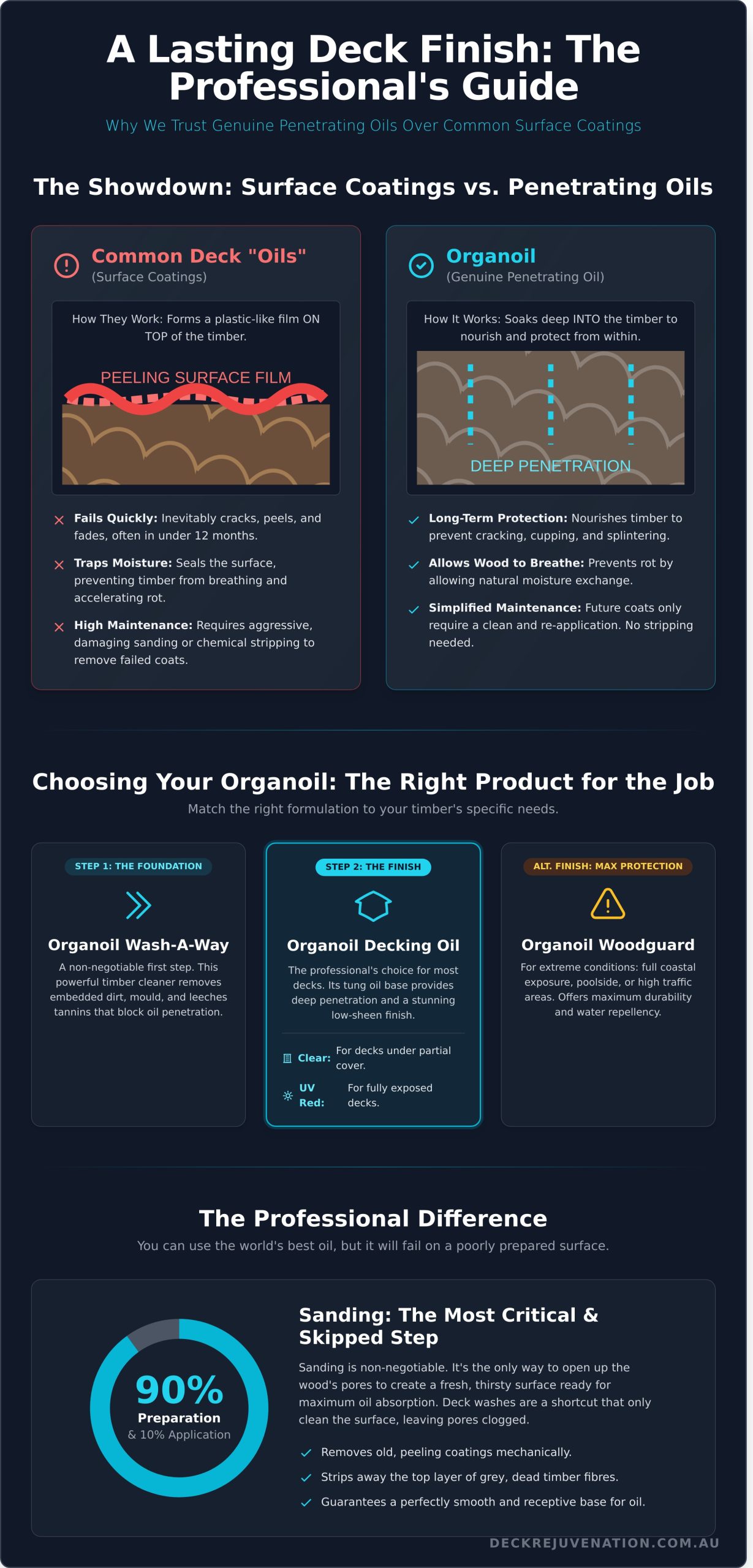
When you’re looking for a decking finish, you’ll find two types on the shelf: coatings that form a film on top of the timber, and oils that penetrate deep into it. As professionals who fix the mistakes caused by inferior products, we only trust the second type. That’s why we use Organoil, a 100% Australian-owned and made range of natural timber oils.
The core philosophy is simple but crucial: feed and protect the timber from within, don’t just put a plastic-like film over it. Organoil uses genuine, sustainably sourced plant oils like Tung Oil, which have a microscopic particle size. This allows the oil to soak deep into the timber grain, nourishing the wood and replenishing the natural oils lost to weathering. This is a fundamental principle of effective wood preservation techniques. In sharp contrast, most common decking “oils” are actually acrylic or solvent-based coatings that sit on the surface. They look good for a few months, but they inevitably crack, peel, and trap moisture, leading to faster timber decay.
The Key Benefits of a Natural Penetrating Oil
Professionals choose a penetrating oil because it works with the timber, not against it. This approach delivers tangible, long-term advantages for the health and appearance of your deck.
- Prevents Timber Degradation: It stops the timber from drying out, dramatically reducing the risk of ugly and dangerous cracking, cupping, and splintering.
- Allows Timber to Breathe: A penetrating oil doesn’t seal the surface. This allows the wood to release and absorb moisture naturally with changing weather, preventing rot from being trapped underneath.
- Authentic Finish: It enhances the natural grain and colour of the wood, providing a rich, matte finish that feels like real timber underfoot, not a layer of plastic.
- Simplified Future Maintenance: There is no film to fail. Future coats don’t require aggressive, damaging sanding or chemical stripping. A proper clean and a re-application is all that’s needed to restore protection.
Australian Made for Australian Conditions
A product made in Europe or America isn’t formulated for our environment. Organoil is developed and manufactured in Australia, specifically to withstand our country’s punishing climate. It contains UV-blocking properties to combat the harsh sun and is robust enough to handle Melbourne’s wildly variable weather. Its natural composition also helps inhibit the growth of mould and mildew, keeping your deck healthier for longer. By choosing it, you’re not only getting a superior result but also supporting a local Australian company.
Choosing the Right Organoil Product for Your Timber Deck
Selecting the correct oil for your deck isn’t a matter of guesswork; it’s about matching the right formulation to your timber’s specific needs and exposure level. A cheap, one-size-fits-all product will always deliver a subpar result. We exclusively use Organoil because their range provides specific, high-performance solutions for different scenarios. For most homeowners, the choice comes down to two primary finishing oils and one non-negotiable preparation product.
Organoil Decking Oil: The Go-To Choice
For the vast majority of new and existing timber decks, Organoil Decking Oil is the professional’s choice. Its genuine tung oil base is designed for deep penetration, feeding the timber from within rather than just sitting on top. This preserves the timber’s natural feel and provides a stunning, low-sheen finish that highlights the grain. It’s available in two key variants:
- Clear: Ideal for decks under partial cover or when you want to maintain the timber’s original, unaltered colour as much as possible.
- UV Red: This is our standard recommendation for decks fully exposed to the harsh Australian sun. The natural red pigment acts as a sacrificial sunscreen, providing superior protection against UV degradation and extending the life of the finish.
Organoil Woodguard: For Maximum Weather Protection
When a deck faces extreme conditions-such as full coastal exposure, constant poolside splashing, or exceptionally high foot traffic-we step up to Organoil Woodguard. This product features a more robust formulation designed for maximum durability and water repellency. While still a penetrating oil, its composition leverages principles of advanced wood preservation technology to create a tougher barrier against the elements, preventing moisture ingress and weather-related damage more effectively than a standard oil.
Essential Prep: Organoil Wash-A-Way
Let’s be direct: no oil will perform correctly if applied to a dirty or improperly prepared surface. This is a non-negotiable first step and a corner many DIYers and cheap contractors cut. Organoil Wash-A-Way is not just a detergent; it’s a powerful, purpose-built timber cleaner. It effectively removes embedded dirt, grime, mould spores, and most importantly, it helps leech out the natural tannins in new hardwoods that actively block oil penetration. A meticulous clean with Wash-A-Way is the foundation of a long-lasting, professional finish.
The Professional Difference: Why Preparation is 90% of the Job
Let’s be direct: you can use the world’s best decking oil, but it will fail in months on a poorly prepared surface. This is the hard truth many contractors won’t tell you. A professional restoration isn’t just about applying a coat of oil; it’s about the meticulous, multi-stage process that ensures a premium product like Organoil can actually penetrate and protect your timber. This is the difference between a finish that looks good for a season and one that endures for years. We don’t take shortcuts, because shortcuts lead to failure.
Sanding: The Most Critical and Skipped Step
Sanding is non-negotiable for a professional result. It’s the only way to mechanically remove old, peeling coatings and the top layer of grey, dead timber fibres. This process opens up the wood’s pores, creating a fresh, thirsty surface ready for maximum oil absorption. Our meticulous ‘5 waves of sanding’ process guarantees a perfectly smooth and receptive base. Don’t be fooled by cheap ‘deck wash’ products; they are a shortcut that cleans the surface but leaves the pores clogged and the dead fibres intact, leading to premature finish failure.
Rectifying Cupped and Uneven Boards
Does your deck have boards that curl up at the edges? This is ‘cupping’, a common issue that a simple coat of oil will never fix. Our precision sanding process does more than just prepare the timber; it physically flattens and levels cupped boards. This not only makes your deck safer to walk on but is critical for preventing water from pooling in the troughs of the boards, which is a primary cause of timber rot. Does your deck have cupped boards? Get an honest assessment.
Thorough Cleaning and Brightening
Once the heavy work of sanding is complete, the final preparation begins. First, we conduct a thorough clean to remove every trace of fine dust from the timber grain. Following this, we apply a professional-grade timber brightener. This crucial step neutralises the pH of the wood and balances tannins that can cause discolouration. It ensures the natural colour of your timber shines through and that the final Organoil finish is true, rich, and perfectly consistent across the entire deck.
How to Apply Organoil: A Step-by-Step Guide for Best Results
You’ve done the hard work of preparation; now it’s time for the application. This is where a premium product meets a professional process. Applying a genuine penetrating oil like Organoil isn’t about slapping on a coat and hoping for the best. It’s a meticulous method designed to feed the timber from within, not just sit on top. Follow these steps to get the durable, long-lasting finish your investment deserves.
Step 1-2: Surface Preparation and Cleaning
We can’t stress this enough: your final finish is only as good as your preparation. Before you even think about opening the can, your deck must be fully sanded, cleaned, and completely free of dust. Most importantly, it must be bone dry. In Melbourne’s variable climate, this often means waiting at least 24-48 hours after washing or a rain shower. Any trapped moisture will prevent the oil from penetrating properly. Take a few minutes to tape off surrounding walls, posts, or downpipes to ensure clean, sharp lines.
Step 3-4: Application and Penetration
Use a quality decking applicator pad or a wide brush; cheap tools will leave an uneven finish. Apply a generous first coat, working along the length of 2-3 boards at a time to maintain a wet edge. Don’t be stingy-the goal is to saturate the timber so it can drink up the oil.
- Allow the oil to penetrate for 30-60 minutes.
- Crucial Tip: After this time, use clean, lint-free rags to wipe off ALL excess oil that hasn’t soaked into the wood. If you skip this, you’ll be left with a sticky, tacky surface that attracts dirt and fails to cure.
- Melbourne Weather Alert: Avoid applying on hot, windy days. This causes the oil to flash-dry on the surface before it has a chance to penetrate deep into the timber grain.
Step 5-6: Second Coat and Curing Time
The second coat should be applied while the first is still slightly damp to the touch (often referred to as a “wet-on-damp” application). This allows the two coats to bond together within the timber for maximum protection. Apply this coat in the same manner, and once again, wipe off all excess oil after the 30-60 minute penetration period. This final wipe-down is the key to a professional, non-sticky finish.
Allow the deck to cure for at least 24-48 hours before allowing light foot traffic. Full curing, where the oil hardens completely within the timber, can take several days to a week. Avoid placing heavy furniture or pot plants back onto the deck during this time.
Following this professional method ensures you get the absolute best performance from your decking oil. If you’d rather leave it to the experts, the team at Deck Rejuvenation has this process down to a fine art.
Common Mistakes to Avoid (And Why They Cost You Money)
Using a premium product like Organoil is an excellent choice for protecting your timber deck. However, the best oil in the world will fail if the application is wrong. Over the years, we’ve seen countless DIY projects go sideways, often costing homeowners more to fix than it would have to get it done right the first time. These aren’t just small errors; they are fundamental mistakes that guarantee a poor result.
Here are the most common, costly mistakes we see every week.
Applying Over Old Coatings or Grey Timber
The most frequent shortcut is trying to apply fresh oil directly over a peeling varnish, a failed coating, or grey, weathered timber. This simply does not work. The oil cannot penetrate the dead fibres or old film, so it sits on the surface, unable to protect the wood. The result is a finish that looks patchy and fails within months, wasting both your time and your money on oil.
The Fix: There are no shortcuts. The surface MUST be professionally sanded back to fresh, clean, raw timber. This is the only way to ensure the Organoil can penetrate deep into the grain and provide genuine, long-lasting protection.
Leaving Excess Oil on the Surface
Many people think ‘more is better’ when it comes to decking oil. They flood the surface and leave it to dry, assuming a thick coat means better protection. The opposite is true. This traps solvents and results in a sticky, tacky surface that never properly cures. It becomes a magnet for dirt, dust, and footprints, and is a nightmare to rectify, often requiring a full chemical strip and re-sand.
The Fix: A penetrating oil works by soaking into the timber, not sitting on top of it. Always follow the manufacturer’s instructions and wipe off all unabsorbed, excess oil with a clean cloth after the recommended time to achieve a perfect, satin finish.
Oiling in Poor Weather Conditions
Your choice of day is critical. Applying oil in the direct, hot sun or when rain is forecast is a recipe for disaster. Intense heat can cause the oil to “flash-dry” on the surface before it has a chance to penetrate, creating a weak film. Rain, on the other hand, can wash the oil away or leave you with a splotchy, water-marked mess.
The Fix: Plan your project for a mild, overcast day with temperatures between 15-25°C and no rain expected for at least 24 hours. This gives the oil the ideal conditions to penetrate and cure correctly.
Getting your deck preparation and application right is non-negotiable for a finish that lasts. It requires precision, the right equipment, and an understanding of how timber and oils work together. Don’t risk costly mistakes. Let the professionals handle it.
The Professional Finish: From Preparation to Perfection
As we’ve shown, achieving a superior finish for your timber deck is about far more than the tin of oil. The key takeaway is simple: a premium product like Organoil delivers lasting results only when combined with meticulous preparation and expert application. Cutting corners on the prep work is the single most common and costly mistake, leading to a finish that fails prematurely and costs more to rectify down the track.
This professional difference is what we stand by. As a family business with over 17 years of experience, we provide honest advice, not empty promises. Our meticulous 9-step restoration process is designed to do the job right the first time, ensuring deep oil penetration and genuine, long-term protection for your timber. Your deck is a valuable asset; give it the professional care it truly deserves.
No Shortcuts, Just a Genuine Finish. Get a Free Quote Today.
Frequently Asked Questions About Organoil
How long does Organoil decking oil last on a deck in Melbourne?
In Melbourne’s variable climate, a deck’s exposure is the biggest factor. For a deck fully exposed to harsh sun and rain, you should expect to apply a maintenance coat every 9-12 months. On a more sheltered deck under a roofline, an Organoil finish can last up to 18 months. Proper preparation is non-negotiable; without a meticulously cleaned and prepared surface, no oil can provide genuine, long-lasting protection against Melbourne weather.
Can I use Organoil on a Merbau or Spotted Gum deck?
Yes, absolutely. Organoil is an ideal choice for dense Australian hardwoods like Merbau and Spotted Gum. Its formulation is designed for deep penetration, which is critical for nourishing these naturally oily timbers from within. This prevents the wood from drying, splitting, and cupping. It enhances the natural grain and deep colours of these premium timbers far better than a surface-level coating. Just ensure any new Merbau is properly prepared to draw out tannins first.
Is Organoil better than water-based decking products like Aquadeck?
They work in fundamentally different ways. Water-based acrylics like Aquadeck create a film that sits on top of the timber. This film can look good for a few months, but it will eventually peel, flake, and crack, requiring a costly and difficult stripping process. Organoil is a penetrating oil; it soaks into the timber to protect it from the inside out. It will never peel or crack, making future maintenance a simple clean and re-coat. We always choose penetration over a surface film.
How do I clean and maintain a deck that has been finished with Organoil?
Maintenance is straightforward. For general cleaning, sweep off debris and wash with a pH-neutral cleaner and a soft-bristled broom. Never use a high-pressure washer as it will fur up the timber grain. When the deck begins to look dry or loses colour, it’s time for a maintenance coat. This involves a thorough clean with a professional-grade deck cleaner, allowing it to dry completely, and then applying a single, thin coat of oil. No sanding or stripping is required.
What is the drying time for Organoil before I can walk on the deck?
Drying time is dictated by weather conditions. In warm, dry weather, the deck should be ready for light foot traffic in 24 hours. However, we strongly advise waiting a full 48 to 72 hours before returning furniture or allowing heavy use. This gives the oil sufficient time to penetrate the timber and cure properly. Rushing this critical step will result in a compromised finish and reduced durability. Patience here pays off in the long run.
Is Organoil safe for pets and children once it has dried?
Yes. Once Organoil has fully cured, it is completely safe for your entire family, including pets and children. The product is formulated from natural plant oils and does not contain harsh or toxic chemicals. During the application and curing phase (the first 48-72 hours), it is important to keep the area clear to prevent contact with the wet oil. After that, the surface is non-toxic and ready for normal use.
How much does Organoil cost compared to other decking oils?
Organoil is a premium, Australian-made product, and its upfront cost reflects that, typically ranging from A$120 to A$150 for a 4-litre can. While cheaper hardware store brands may seem like a bargain, it’s a false economy. Those products often lead to costly stripping and sanding down the line. The true value of Organoil is in its long-term performance and the simplicity of maintenance, saving you significant money and labour over the life of your deck.
Leave a Reply